
For years, Domain Rating (DR) has been one of the most recognisable metrics in SEO. From evaluating competitors to researching potential link partners, marketers and agencies have relied on it as a quick indicator of backlink strength.
However, not all high-authority websites are created equal. Artificially inflated scores, questionable backlink networks and subdomains inheriting the authority of established platforms have made interpreting Domain Rating increasingly complicated.
Enter DR4, the fourth generation of Ahrefs' Domain Rating model.
Designed to provide a more meaningful assessment of backlink profiles, DR4 represents an important evolution in how SEO professionals evaluate websites. But what has actually changed, and what does it mean for your business?
DR4 is the fourth version of Ahrefs' Domain Rating — subdomains now get their own score, links from sites with organic traffic count for more, and roughly half as many sites keep a rating at all. It becomes the default on 1 December 2026. Compare your DR3 and DR4 side by side with our free DR checker.
What Is DR4?
DR4 is the fourth iteration of Ahrefs' proprietary Domain Rating metric, which measures the relative strength of a website's backlink profile on a logarithmic scale from 0 to 100.
Ahrefs announced the updated model on 5 November 2026, with the main platform rollout scheduled for 1 December 2026.
The fundamental purpose of Domain Rating remains unchanged. However, DR4 refines which websites influence the calculation and introduces independent ratings for subdomains.
The result is a metric designed to provide a more representative view of individual websites and their backlink strength.
You can explore your website's authority using our free Ahrefs DR checker, or browse the full set of SEO metrics tools.
DR3 vs DR4: What Has Changed?
Although both models use the same 100-point scale, the underlying approach differs.
| Feature | DR3 | DR4 |
|---|---|---|
| Rating scale | 0–100 | 0–100 |
| Primary focus | Backlink strength | Refined backlink strength |
| Subdomains | Generally inherit root domain rating | Independently evaluated |
| Influential referring domains | Broader pool | More selective pool |
| Organic search visibility | Less emphasis | Greater weighting for visible referring sites |
| Inflated authority | More susceptible | Designed to reduce manipulation |
| Ranking correlation | Stronger for root domains in Ahrefs' testing | Stronger across all hosts combined |
Importantly, DR4 remains a backlink-based metric rather than a comprehensive website quality score.
A website's content, user experience, reputation and commercial performance cannot be accurately summarised by Domain Rating alone.
Why Subdomains Now Have Their Own Domain Rating
One of the most significant changes introduced by DR4 is independent subdomain scoring.
Consider a large website-building platform that hosts thousands of independently operated websites. Under the previous model, many of those websites could display the same high Domain Rating as their parent domain, despite having relatively few backlinks of their own.
DR4 distinguishes between the authority of the parent website and the backlink profile of its individual subdomains.
For example, Ahrefs shared the following results during its DR4 preview:
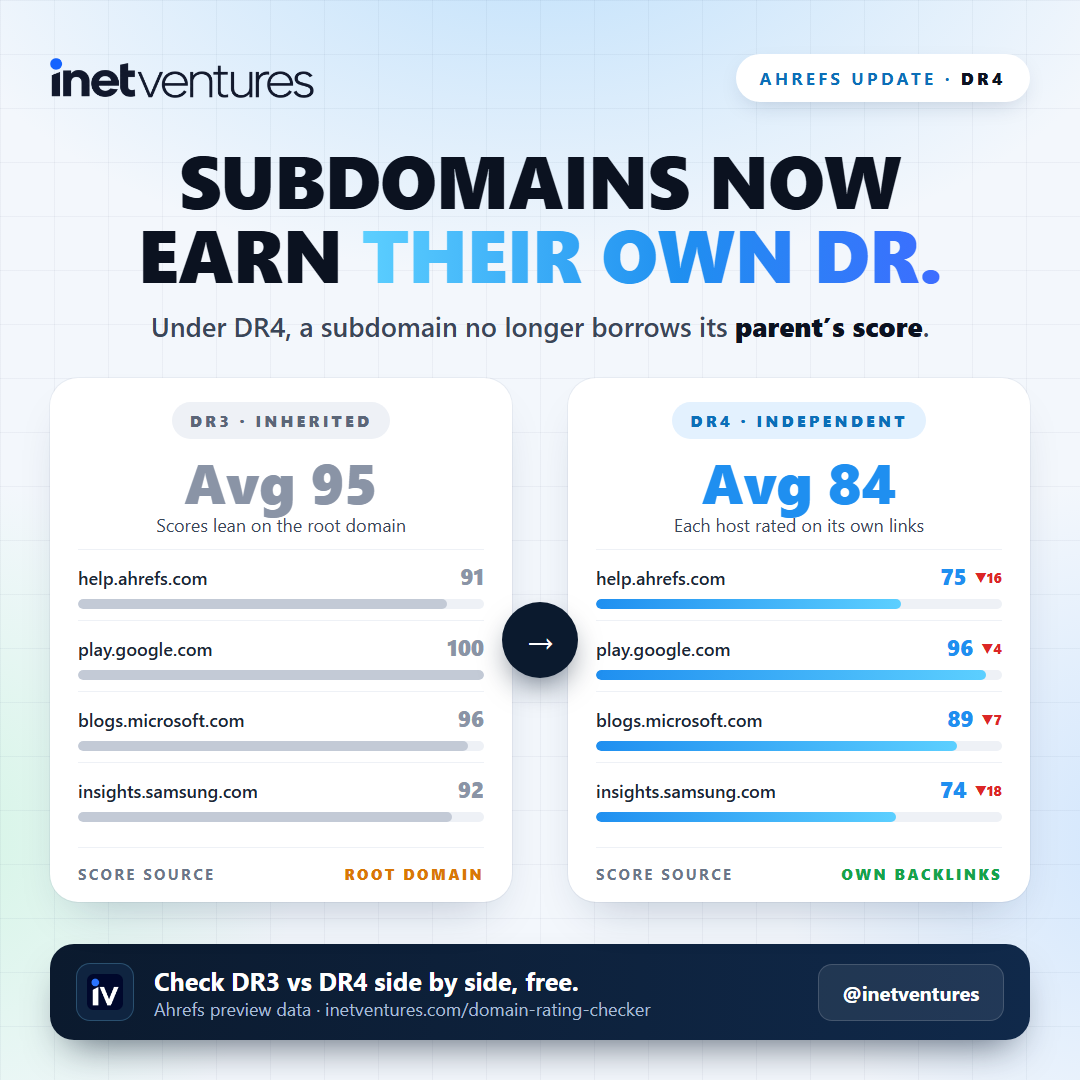
For SEO professionals, the practical implication is significant. A backlink from a small hosted blog should not automatically be treated as equivalent to a backlink from the platform's main website.
When researching opportunities, check the actual hostname where your content or backlink will appear. Our Domain Rating checker accepts subdomains directly — enter blog.example.com to see its independent score.
Authority Link Building
Monthly retainer combining Blogger Outreach, Link Insert and Digital PR placements. Track everything via your live dashboard.
How Organic Traffic Influences DR4
A website with thousands of backlinks but very little search visibility can be difficult to evaluate. Its backlink profile may be legitimate, but it could also contain artificial links or outdated authority signals.
DR4 places greater emphasis on backlinks originating from websites with estimated organic search traffic.
According to the official Ahrefs DR4 announcement, this revised approach approximately halves the population of websites receiving a Domain Rating.
However, this does not mean increasing your own organic traffic automatically increases your DR.
Domain Rating and organic traffic measure different aspects of website performance. A site can attract substantial search traffic with relatively modest backlink authority, while another can possess a strong backlink profile without generating significant search visits.
This is why evaluating multiple SEO metrics together remains important.
Why Has My Domain Rating Dropped?
A sudden decrease in Domain Rating can be concerning, especially when you have spent considerable time developing your website.
However, a change in DR does not necessarily indicate that something has gone wrong. There are several reasons why your score might decrease:
- Changes to the underlying Domain Rating calculation.
- Reduced influence from certain referring websites.
- Lost or weakened backlinks.
- Changes to how subdomains are evaluated.
- Improvements in the backlink profiles of other websites.
- Previously influential links receiving less weight.
Imagine that your website moves from DR 52 to DR 44 following a model update. If your backlinks, rankings, organic traffic and enquiries remain stable, the lower score may simply reflect a different measurement methodology.
Your website has not necessarily become less valuable overnight.
What should you do if your DR drops?
Start by checking whether your website has experienced an actual decline in performance. Compare your organic traffic, referring domains, keyword rankings and conversions before and after the change.
It is also worth reviewing the Domain Rating of your closest competitors. If several websites in your industry have experienced similar movements, the change may be related to the scoring model rather than an individual problem.
Avoid making significant SEO decisions based solely on a change in one third-party metric.
Does DR4 Make Fake Domain Ratings Harder to Achieve?
Domain Rating manipulation has been a concern within the SEO industry for years. Some websites develop impressive-looking authority metrics without establishing a meaningful audience, reputable content or genuine editorial relationships.
DR4 attempts to address some of these weaknesses.
In Ahrefs' preview testing, websites classified as spam with previous DR scores between 30 and 70 experienced median reductions of approximately 15–20 points.
Nevertheless, no automated SEO metric is perfect.
A high DR4 score should never be interpreted as proof that a website is trustworthy, while a low score should not automatically be considered evidence of spam.
Manual evaluation remains essential.
What Is a Good DR4 Score?
There is no universally ideal Domain Rating.
A DR 35 specialist website could be highly competitive within a narrow industry, while a DR 70 publication might face considerable competition in a broader market.
The following ranges provide a general starting point.
| Domain Rating | Indicative backlink strength |
|---|---|
| 0–20 | Emerging |
| 21–40 | Developing |
| 41–60 | Established |
| 61–80 | Very strong |
| 81–100 | Exceptional |
These are illustrative iNet Ventures benchmarks, not official Ahrefs classifications.
The most meaningful comparison is between websites operating in similar industries, serving similar audiences and competing for similar search queries.
A smaller website with an engaged readership, original content and relevant editorial backlinks can be commercially more valuable than a much higher-DR website.
What DR4 Means for Link Building and Digital PR
The introduction of DR4 presents an opportunity for businesses to reconsider how they evaluate backlinks.
Historically, many campaigns have been built around rigid authority thresholds. For example, an agency might only consider websites with a Domain Rating above 40, regardless of their relevance, readership or editorial standards.
Although thresholds can help narrow down large prospect lists, they should not replace comprehensive research. When evaluating potential websites, consider:
- Topical relevance: Does the website cover subjects relevant to your business?
- Organic visibility: Does it attract meaningful search traffic?
- Backlink diversity: Does it receive links from a variety of credible sources?
- Editorial quality: Does it publish original, useful content?
- Traffic geography: Does its audience align with your target markets?
- Outbound links: Does it link naturally to other websites?
- Historical performance: Has its visibility remained reasonably consistent?
For businesses investing in digital PR, earning coverage that reaches genuine audiences should remain a priority.
Where placements are paid or sponsored, publishers should also follow Google's guidance on qualifying outbound links.
Build E-E-A-T Authority
Expert quotes via Digital PR — your spokesperson quoted in DR 50+ publications.
DR4 vs Domain Authority and Trust Flow
Ahrefs is not the only provider measuring website authority. Moz and Majestic offer their own metrics, each based on different datasets and methodologies.
| Metric | Provider | Primary purpose |
|---|---|---|
| Domain Rating (DR) | Ahrefs | Relative backlink profile strength |
| Domain Authority (DA) | Moz | Predicted ranking potential |
| Page Authority (PA) | Moz | Predicted ranking potential of individual pages |
| Trust Flow (TF) | Majestic | Link trust and quality |
| Citation Flow (CF) | Majestic | Link influence |
These scores are not interchangeable.
A website with DR 50 may have DA 35 and Trust Flow 20. This does not automatically suggest manipulation; the providers crawl different parts of the web and calculate their metrics differently.
Our Domain Authority Checker provides another way to evaluate website authority using Moz data — showing DR, DA, PA and Spam Score side by side.
For more comprehensive research, our Bulk Domain Intelligence tool brings together metrics from multiple providers, alongside organic traffic and additional domain insights.
How to Improve Your Domain Rating
While the methodology behind Domain Rating may evolve, the principles of developing a strong backlink profile remain broadly consistent.
Create content worth referencing
Original research, useful statistics, industry surveys, calculators and comprehensive guides can attract editorial backlinks naturally. Give other publishers a genuine reason to reference your website.
Invest in digital PR
Relevant media coverage can introduce your business to new audiences while helping establish recognition within your industry. Develop stories around original insights, interesting data and genuine expertise rather than pursuing authority metrics in isolation.
Reclaim lost backlinks
Websites change over time. Articles are removed, URLs are redirected and previously earned backlinks can disappear. Regularly reviewing your backlink profile can help identify valuable references that may be recoverable.
Build industry relationships
Relationships with journalists, publishers, businesses and industry professionals can lead to natural collaborations and editorial coverage.
Prioritise relevance over volume
Accumulating large numbers of backlinks from unrelated websites is rarely a sustainable objective. Focus on building a diverse backlink profile that reflects your business, industry and audience.
How to Check Your DR4 Score
Ahrefs introduced access to DR4 through its Domain Rating API ahead of the wider platform rollout.
Website owners can use Ahrefs or compatible third-party SEO tools to investigate their Domain Rating. Our free bulk Domain Rating checker shows your current DR score alongside the incoming DR4 model — including the difference between the two — for domains and subdomains alike.
When using external checkers during a model transition, confirm which version of Domain Rating the tool returns. Different versions, caching periods and data refresh schedules may explain why two tools display different results.
For larger website lists, bulk analysis can make comparing competitors and potential link partners significantly more efficient — our bulk DR checker handles up to 25 domains per request with a free account.
Check your DR4 score before the switch
See your current Domain Rating and the incoming DR4 model side by side — free, for up to 25 domains at once.
Frequently Asked Questions
Is DR4 a Google ranking factor?
No. DR4 is a proprietary Ahrefs metric. Google does not use the Ahrefs Domain Rating score as a direct ranking factor.
Is DR4 more accurate than DR3?
Ahrefs' testing found a stronger relationship between DR4 and Google rankings when root domains and subdomains were analysed together. However, DR3 performed better in its root-domain-only comparison. Accuracy depends partly on what you are trying to measure.
Will all websites experience a DR change?
Not necessarily. Some websites may gain points, others may lose points, and many may experience little or no change.
Can a low-DR website outrank a high-DR website?
Yes. Search rankings depend on many factors, including content relevance, competition, search intent and page-level signals.
Does a higher DR4 score mean more organic traffic?
No. A stronger backlink profile does not guarantee greater search visibility or traffic.
Can Domain Rating still be manipulated?
No third-party authority metric is completely immune to manipulation. DR4 aims to reduce certain weaknesses, but website quality should still be assessed independently.
Should I change my link-building strategy because of DR4?
Use the updated metric as an opportunity to review your evaluation criteria. Focus on relevant websites, genuine audiences, editorial standards and sustainable marketing practices.
The Future of Domain Rating
DR4 reflects a wider shift towards more nuanced website evaluation.
As the internet continues to grow, distinguishing between established platforms, independently operated websites and artificially inflated backlink profiles becomes increasingly important.
Domain Rating remains a useful starting point, but the most informed SEO decisions come from looking beyond any individual score.
At iNet Ventures, we believe website evaluation should combine authority, relevance, visibility and genuine editorial quality.
Whether you're researching competitors, evaluating potential partnerships or planning your next digital PR campaign, explore our SEO tools to make better-informed decisions with data from multiple sources.

James is the founder and CEO of iNet Ventures, bringing over two decades of experience in SEO, link building, and online growth. He has helped online agencies scale through white-label solutions and has overseen the delivery of 25,000+ links, combining proven strategies with AI-driven workflows to drive efficient, long-term results.
View More Posts

