
Starting an SEO agency has arguably never been easier. Building one that consistently attracts profitable, long-term clients is another matter entirely.
Artificial intelligence has lowered the barriers to entering the industry. Businesses can generate content, conduct preliminary keyword research and identify technical website issues without hiring an agency. At the same time, competition between SEO providers is becoming increasingly intense.
For agencies, consultants and freelancers, the challenge in 2027 is not simply demonstrating that SEO is important. It is demonstrating why a business should trust you to manage it.
Whether you are looking for your first SEO client or trying to scale an established agency, the following strategies can help you develop a more reliable pipeline of opportunities.
The Best Ways to Get SEO Clients at a Glance
| Strategy | Cost | Speed to generate leads | Long-term potential |
|---|---|---|---|
| Personalised cold outreach | Low | Fast | High |
| AI-assisted prospecting | Low–Medium | Fast | High |
| Client referrals | Low | Medium | Very high |
| LinkedIn marketing | Low | Medium | High |
| Free SEO assessments | Low–Medium | Fast | High |
| Agency partnerships | Low | Medium | Very high |
| Ranking your own website | Medium | Slow | Very high |
| Original research | Medium–High | Slow | High |
| Paid advertising | High | Fast | Medium–High |
| Local business networking | Low | Medium | High |
The assessments above are indicative rather than measured industry benchmarks. Results depend on your positioning, experience, target market and execution.
The strongest approach is usually to combine two or three complementary strategies rather than attempting everything simultaneously.
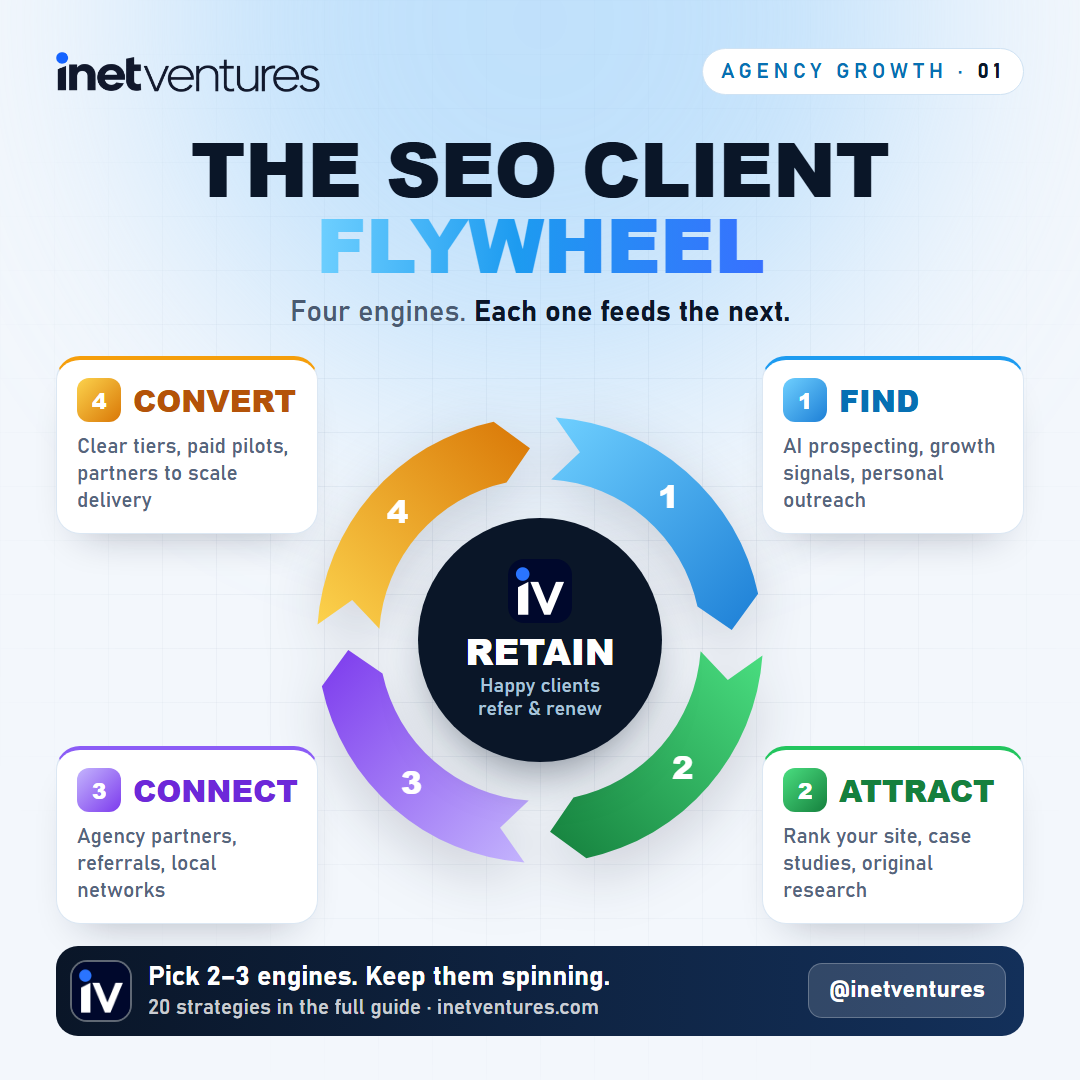
Part One: Finding and Approaching SEO Clients
1. Choose an Industry to Specialise In
One of the biggest mistakes new SEO agencies make is trying to sell their services to everyone.
A marketing director at a software company has very different priorities from the owner of a dental practice. Their customers, competitors, buying cycles and search behaviour are fundamentally different.
Specialising allows you to develop a clearer proposition and demonstrate knowledge that a generalist agency may lack.
Potential industries include:
- SaaS and technology.
- Finance and insurance.
- E-commerce.
- Legal services.
- Healthcare and dentistry.
- Property and construction.
- Travel and hospitality.
Consider the difference between advertising yourself as an SEO agency and positioning yourself as an SEO specialist helping independent dental practices generate more patient enquiries.
The second proposition communicates an audience, a problem and a commercial outcome.
You do not necessarily need to reject clients outside your chosen industry. Specialisation primarily makes your marketing more focused.
2. Use AI to Identify Better SEO Prospects
AI can dramatically reduce the time required to research potential SEO clients.
Rather than manually reviewing hundreds of websites without a clear process, use SEO platforms to identify businesses that fit your criteria and AI to help organise the findings.
Tools such as Ahrefs and Semrush can help uncover potential opportunities, including:
- Declining organic search visibility.
- Commercial pages ranking just outside the first page of Google.
- Competitors attracting significantly more organic traffic.
- Weak or outdated website content.
- Businesses with limited visibility despite an established brand.
Export the relevant data and use AI to categorise prospects according to their potential commercial value.
For example, you could ask an AI assistant to analyse a spreadsheet of businesses and prioritise those with an established product offering, declining estimated organic traffic and identifiable content opportunities.
Always verify the findings manually before contacting a prospect. Third-party traffic estimates are not the same as actual website analytics, and AI can misinterpret incomplete data.
The objective is to improve the quality of your prospect list, not simply increase its size.
Analyze Your Backlink Profile
Get detailed insights into your backlink quality with Moz, Ahrefs & Majestic data combined.
3. Send Personalised Cold Emails
Cold email remains a potential source of SEO clients, but generic mass outreach offers little reason for a business owner to respond.
Messages claiming that a website has serious SEO problems without providing any evidence are easy to ignore.
A stronger approach is to identify one specific opportunity and explain its relevance to the business.
Hi [First name],
I came across [Company] while researching businesses in the [industry] sector.
I noticed that your page covering [service or product] appears to have an opportunity to improve its visibility for [relevant search term], particularly when compared with several competing businesses.
I've identified a couple of practical improvements that may help.
Would you be interested in seeing a short breakdown?
Best regards,
[Your name]
The purpose of the initial email is to start a conversation, not sell a twelve-month SEO contract immediately.
Keep messages concise, verify your observations and avoid unrealistic promises.
Agencies should also understand applicable privacy and direct marketing regulations. In the UK, the ICO's business-to-business marketing guidance explains the different requirements for contacting companies, sole traders and other business structures. Respect opt-out requests and maintain appropriate suppression lists.
4. Find Businesses Already Spending Money on Marketing
Companies investing in paid advertising may be particularly interesting SEO prospects because they have already recognised the value of online customer acquisition.
Look for businesses running Google Ads, sponsoring industry newsletters or promoting products through social media.
Paid search advertisers may have a commercial incentive to develop an additional source of customer acquisition through organic search.
However, avoid presenting SEO and PPC as competing strategies that cannot coexist.
A more compelling proposition is to explain how SEO could complement their existing advertising, improve visibility across the customer journey and potentially reduce dependence on any single acquisition channel over time.
5. Approach Businesses With Declining Search Visibility
A company that previously performed well in organic search may understand the value of SEO more readily than a business that has never invested in it.
Historical visibility data can help identify websites experiencing declines.
Possible causes include:
- Website migrations.
- Outdated content.
- Increased competition.
- Technical problems.
- Changes in search demand.
- Google algorithm updates.
Do not assume that a decline is evidence of a penalty or poor agency performance.
Instead, investigate the website and offer a measured assessment of what may have changed.
Businesses experiencing a genuine decline may be motivated to understand the cause and explore recovery options.
6. Monitor Business Growth Signals
Timing can be just as important as the quality of your sales pitch.
A business opening a new location, launching a product or expanding internationally may need marketing support that it did not require six months earlier.
Useful prospecting signals include:
- Recent funding announcements.
- New marketing appointments.
- Product launches.
- Website redesigns.
- Expansion into new territories.
- Recruitment of marketing personnel.
- Acquisitions and mergers.
LinkedIn, company announcements and industry publications are useful sources for identifying these developments.
An SEO proposal connected to a genuine business event is likely to feel more relevant than an unsolicited offer arriving without context.
Part Two: Building an Inbound SEO Lead Generation System
7. Rank Your Own Agency Website
Your own website is an opportunity to demonstrate the expertise you sell.
While competitive terms such as SEO agency can be difficult to rank for, there are numerous more specific opportunities.
Consider developing useful service pages and resources targeting searches such as:
| Keyword type | Example |
|---|---|
| Industry-specific | SEO for accounting firms |
| Location-specific | SEO agency Birmingham |
| Problem-specific | How to recover lost organic traffic |
| Commercial | Ecommerce SEO services |
| Comparison | SEO agency vs in-house SEO team |
| Pricing-related | How much does SEO cost? |
A well-developed agency website can attract potential clients at different stages of their buying journey.
Avoid creating hundreds of near-identical location or industry pages. Each page should address the genuine needs of its intended audience.
Your website should demonstrate your expertise, not merely advertise it.
8. Publish Case Studies That Demonstrate Business Results
A screenshot showing increased organic traffic can be useful, but it rarely tells the complete story.
Potential clients want to understand what you achieved, how you achieved it and whether the results are relevant to their own business.
An effective SEO case study should include:
- The client's original objectives.
- The problems identified.
- The strategy implemented.
- The timeframe involved.
- The results achieved.
- Any relevant limitations or external factors.
Where possible, connect SEO performance to qualified enquiries, sales, bookings or other meaningful business outcomes.
Use genuine data and obtain permission before sharing confidential client information.
A case study showing how you helped a business generate additional enquiries may be considerably more persuasive than one focusing exclusively on keyword rankings.
9. Offer a Focused Free SEO Assessment
Free SEO audits are common, but many provide little more than automated software reports.
Business owners may receive dozens of warnings about missing metadata, image attributes and technical scores without understanding what any of them mean commercially.
A better approach is to offer a focused assessment identifying three to five meaningful opportunities.
For example, an e-commerce assessment might investigate category page visibility, internal linking and search demand for important product ranges.
A local business assessment might focus on service pages, local search visibility and the clarity of its enquiry process.
Keep the initial assessment manageable. A comprehensive technical audit is valuable professional work and can form part of a paid engagement.
The free assessment should establish your credibility and demonstrate how you think.
Authority Link Building
Monthly retainer combining Blogger Outreach, Link Insert and Digital PR placements. Track everything via your live dashboard.
10. Build a Professional Presence on LinkedIn
LinkedIn can help SEO consultants and agency owners develop relationships with business decision-makers before they actively begin looking for an agency.
Useful topics include:
- Website improvements with practical explanations.
- Analysis of search industry changes.
- Common mistakes businesses make when investing in SEO.
- Lessons from anonymised campaigns.
- Commentary on AI and organic search.
- Advice for marketing managers.
Avoid making every post a direct sales pitch.
An agency owner who consistently shares useful insights can build recognition among potential clients, referral partners and other marketing professionals.
Meaningful participation in relevant discussions can also be valuable, particularly when your own audience is still relatively small.
11. Create Free Tools and Resources
Free resources can attract prospective SEO clients while demonstrating the depth of your expertise.
Examples include:
- SEO budget calculators.
- Website migration checklists.
- Organic traffic forecasting spreadsheets.
- SEO reporting templates.
- Content audit worksheets.
- SEO return-on-investment calculators.
The best tools address questions your target customers genuinely have.
For example, an SEO ROI calculator could allow businesses to estimate the potential value of additional organic visitors based on conversion rates and average order values.
Make assumptions clear and avoid presenting projections as guaranteed outcomes.
A useful resource may continue attracting visitors, industry references and potential enquiries long after its initial publication.
12. Publish Original Research
Original research has become increasingly valuable in an environment where generic information can be reproduced almost instantly using AI.
Instead of publishing another article explaining basic SEO concepts, investigate a question that is particularly relevant to your industry.
Research ideas could include:
- How independent law firms perform in organic search.
- The relationship between local reviews and search visibility.
- Common technical problems across e-commerce websites.
- How frequently AI assistants mention competing brands.
- Search visibility trends across a particular industry.
Publish your methodology, explain the limitations and make the findings easy to understand.
Original research can support lead generation, social media activity and wider publicity, while giving potential customers a reason to remember your agency.
13. Demonstrate Your Understanding of AI Search
Business owners increasingly want to understand how AI-generated answers may affect their online visibility.
This creates an opportunity for SEO agencies to educate clients rather than simply sell another fashionable acronym.
Topics worth addressing include:
- Google AI Overviews and AI Mode.
- Brand visibility within AI assistants.
- The importance of reliable, original information.
- Product and service discovery through conversational search.
- Measuring visibility beyond traditional rankings.
According to Google Search Central's guidance on AI features, established SEO principles remain relevant to its AI-powered search experiences.
Agencies should avoid promising guaranteed inclusion in AI-generated answers.
Instead, explain how useful content, technical accessibility, credible information and broader brand visibility can contribute to a more resilient search strategy.
Part Three: Generating SEO Clients Through Relationships
14. Partner With Web Design and Development Agencies
Web design agencies regularly work with businesses launching new websites or improving existing ones.
However, not every design or development agency has an in-house SEO department.
Building relationships with these companies can create opportunities for both parties.
You may provide technical SEO support, migration planning, ongoing optimisation or content strategy, while the development agency continues managing website improvements.
Partnerships can operate through referrals, collaborative projects or agreed white-label arrangements.
Approach agencies whose services complement your own rather than those with whom you directly compete.
A handful of productive agency relationships can potentially generate more consistent opportunities than continually prospecting for individual businesses.
15. Introduce a Client Referral Programme
Satisfied clients are among the most valuable potential sources of new business.
They already understand your service, have established trust and may know other business owners facing similar challenges.
Consider introducing a referral arrangement that offers:
- Account credits.
- A complimentary additional service.
- A referral payment where appropriate.
- Another mutually agreed incentive.
Keep the process straightforward and transparent.
The best time to request a referral is often after a meaningful milestone, when a client has received clear value from your work.
16. Reconnect With Previous Leads and Clients
Not every unsuccessful sales conversation represents a permanent rejection.
A prospect may have lacked the budget, internal resources or urgency to proceed at the time.
Circumstances change.
Maintain appropriate records of previous enquiries and periodically revisit relevant opportunities, respecting marketing permissions and opt-outs.
A useful reason to reconnect might be a new business development, a relevant industry change or an updated assessment of their website.
Former clients can also be valuable contacts, particularly when you previously maintained a positive working relationship.
A conversation with someone who already knows your agency may be easier to establish than one with a completely unfamiliar prospect.
17. Build Relationships Within Your Local Business Community
Despite the global nature of digital marketing, local business relationships should not be underestimated.
Many business owners prefer dealing with providers they can meet and establish a personal relationship with.
Consider attending business exhibitions, networking events, chamber of commerce meetings and industry gatherings.
You could also run a short educational workshop explaining how local businesses can improve their search visibility.
The objective is not to turn every conversation into a sales opportunity. It is to develop genuine relationships and become someone people associate with SEO expertise.
Part Four: Turning SEO Leads Into Paying Clients
Build E-E-A-T Authority
Expert quotes via Digital PR — your spokesperson quoted in DR 50+ publications.
18. Make Your Pricing and Proposals Easier to Understand
Complicated SEO proposals can create unnecessary friction.
Prospective clients should understand what they are purchasing, why it matters and how success will be assessed.
Consider structuring your services around clear stages.
| Service | Suitable for |
|---|---|
| One-off SEO audit | Businesses needing an initial assessment |
| Technical SEO project | Websites with defined technical challenges |
| Monthly SEO retainer | Businesses seeking sustained improvement |
| SEO consultancy | Companies with existing internal marketing teams |
| Content and authority campaign | Businesses investing in broader search visibility |
Your proposal should explain the agreed objectives, deliverables, estimated timeframe, responsibilities and reporting arrangements.
Avoid guarantees of specific rankings or traffic levels.
As Google's SEO Starter Guide makes clear, there is no automatic route to the top of its search results.
Sell a credible process and measurable deliverables rather than an outcome you cannot control.
19. Offer a Paid Pilot Project
Some prospective clients may be reluctant to commit to a significant monthly retainer before experiencing your work.
A paid pilot project can provide a lower-risk starting point.
Examples include:
- A technical SEO assessment.
- Optimisation of a defined group of commercial pages.
- A content strategy for a new product category.
- A local SEO improvement project.
- A competitor and market opportunity analysis.
Define the scope and expected deliverables before beginning.
A pilot should provide genuine standalone value rather than functioning merely as a disguised sales presentation.
If the relationship works well, both parties can explore an ongoing arrangement from a stronger position.
20. Build the Infrastructure to Scale Your Agency
Winning SEO clients is only beneficial if your agency can deliver the work profitably and consistently.
As your client portfolio grows, managing technical audits, content production, reporting, publisher relationships and campaign delivery internally can become increasingly demanding.
Hiring permanent employees is one option, but it is not always the most flexible or economical solution.
Specialist outsourcing can help agencies manage changing workloads without committing to unnecessary overheads.
For example, iNet Ventures provides blogger outreach services, publisher research and white-label reporting for agencies that need additional campaign delivery capacity.
Agencies can also explore digital PR and other authority-building services according to their clients' individual objectives.
When planning paid publisher placements, ensure appropriate disclosure and link qualification. Google's spam policies distinguish legitimate advertising and sponsorship from paid links intended to manipulate rankings.
The important principle is to retain control of your overall strategy, quality standards and client relationships while working with reliable specialist partners.
How to Win SEO Clients With No Existing Case Studies
New agencies and independent consultants face a familiar challenge: clients want evidence of previous success, but obtaining that evidence requires clients.
Fortunately, there are other ways to demonstrate your abilities.
Start by developing a website of your own. Choose a manageable niche, publish useful content and document your progress.
You could also undertake a small, clearly scoped project for an independent business or charity, with permission to share the resulting work.
Other ways to establish credibility include publishing detailed website analyses, demonstrating technical expertise and producing useful educational resources.
Be transparent about your experience.
Claiming results you did not achieve or using fabricated case studies creates significant reputational risk.
A thoughtful assessment that demonstrates genuine ability can be more persuasive than vague claims about years of experience.
How Much Is an SEO Client Worth to Your Agency?
Understanding client value helps determine how much you can reasonably invest in acquiring new business.
Consider an illustrative agency charging an average monthly retainer of $1,500, with an average client relationship lasting twelve months.
| Metric | Illustrative amount |
|---|---|
| Monthly retainer | $1,500 |
| Average relationship | 12 months |
| Total client revenue | $18,000 |
| Direct delivery costs | $9,000 |
| Gross profit before acquisition | $9,000 |
| Client acquisition cost | $1,000 |
| Remaining contribution | $8,000 |
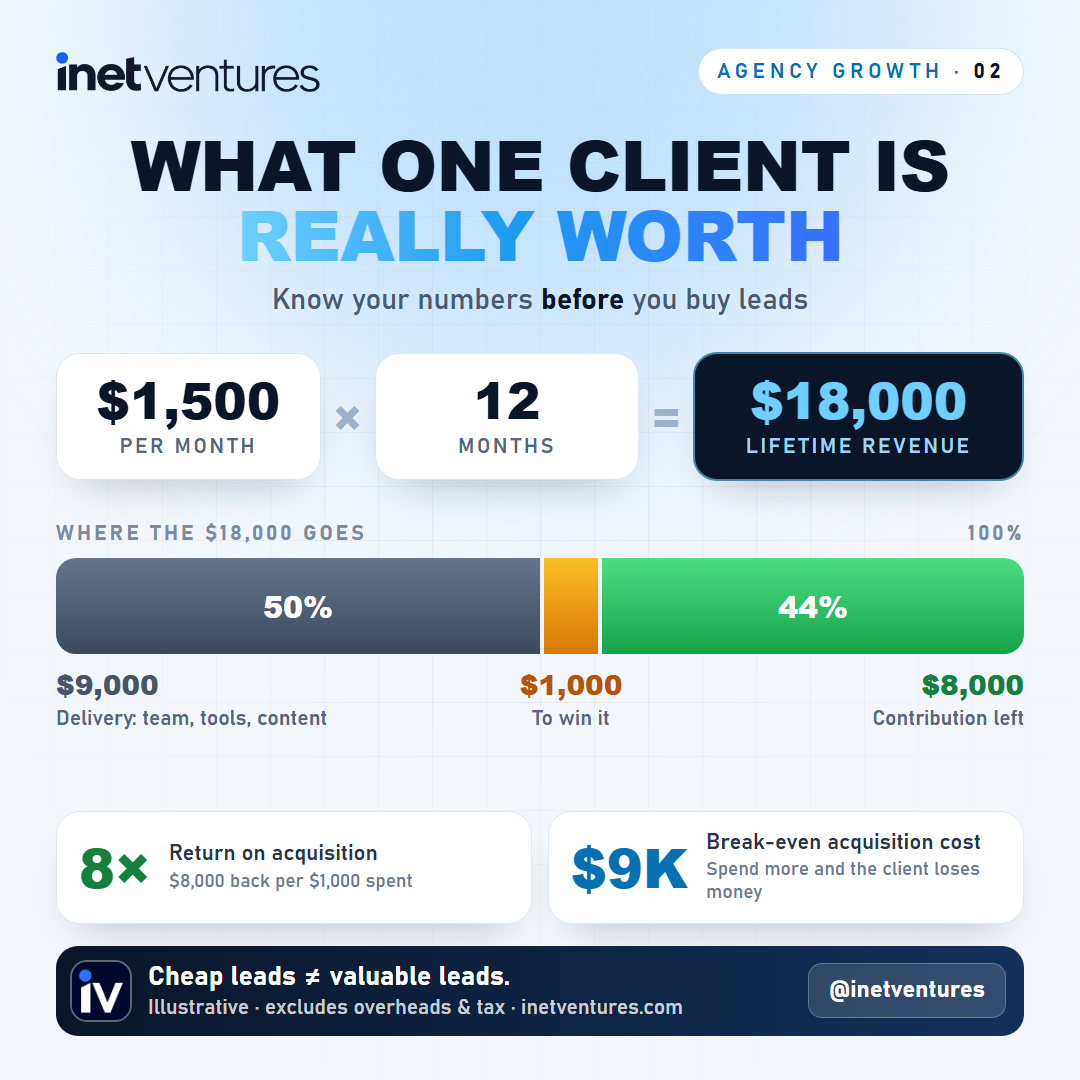
This example excludes general overheads, taxes and other business expenses.
An agency with these economics could potentially justify spending $1,000 to acquire a suitable client, whereas a freelancer selling one-off $300 audits would need a different acquisition model.
The key is understanding your own numbers.
Cheap leads are not necessarily valuable leads. A more expensive acquisition channel may deliver better results if it consistently attracts profitable, long-term clients.
A Practical 30-Day SEO Client Acquisition Plan
Rather than attempting all twenty strategies immediately, begin with a structured programme.
| Period | Activities |
|---|---|
| Week 1 | Define your target industry, ideal client and core offer. Improve your service pages and prepare an assessment template. |
| Week 2 | Research 50 qualified businesses, identify genuine opportunities and begin personalised outreach. |
| Week 3 | Research another 50 businesses, follow up appropriately, publish useful LinkedIn content and approach potential agency partners. |
| Week 4 | Conduct discovery conversations, prepare proposals, review conversion rates and refine your targeting. |
For an established agency, these activities can become part of a continuous weekly workflow.
Track the complete acquisition process, including:
- Qualified prospects researched.
- Relevant outreach messages delivered.
- Positive responses.
- Discovery meetings.
- Proposals submitted.
- Clients acquired.
- Acquisition costs.
- Client profitability and retention.
This allows you to identify where problems exist.
If prospects respond but rarely agree to a meeting, your offer may need improvement. If meetings consistently occur but proposals are rejected, investigate pricing, positioning and the sales process.
Treat client acquisition as a measurable business function rather than an occasional activity when workloads become quiet.
Keeping SEO Clients Is Just as Important as Finding Them
An agency constantly replacing departing clients is unlikely to achieve sustainable growth.
Client retention begins with setting realistic expectations and agreeing on meaningful objectives.
Provide reports that explain what happened, why it matters and what you intend to do next.
Useful reporting metrics may include:
- Organic clicks and impressions.
- Commercial keyword visibility.
- Qualified enquiries and conversions.
- Technical improvements.
- Content performance.
- Relevant media coverage and brand mentions.
Google Search Console provides valuable first-party search performance information, which can be combined with analytics and sales data to provide a more comprehensive picture.
Communicate openly when results are disappointing. Explain potential causes, distinguish verified findings from assumptions and outline your response.
Clients should feel that their agency understands their business, not simply that it monitors a collection of SEO metrics.
Frequently Asked Questions
What is the fastest way to get SEO clients?
Personalised outreach, referrals and reconnecting with previous prospects are among the strategies that can produce conversations relatively quickly. Inbound channels such as organic search and original research generally require a longer-term investment.
How do beginners find their first SEO client?
Start with a clearly defined audience and a manageable offer, such as a website assessment or local SEO project. Demonstrate your abilities through your own projects, useful public content and genuine assessments rather than unsupported claims.
Is cold email still effective for SEO lead generation?
It can be effective when messages are relevant, personalised and based on genuine observations. High-volume generic outreach can damage your reputation and email deliverability while producing poor-quality conversations.
Can AI help me get more SEO clients?
Yes. AI can assist with prospect research, data analysis, opportunity identification, drafting personalised communications and preparing proposals. Human verification and meaningful relationship building remain important.
How much should I charge SEO clients?
Pricing should reflect the complexity of the work, your experience, delivery costs, competition and the potential value to the client. Avoid competing solely on price or offering services at rates that prevent you from delivering quality work.
Is it worth starting an SEO agency in 2027?
There remains a business opportunity for agencies that understand search behaviour, customer acquisition, technical optimisation and the changing role of artificial intelligence.
However, agencies relying entirely on generic content production or superficial reporting may find it increasingly difficult to demonstrate their value.
Should SEO agencies outsource their work?
Outsourcing can provide flexibility and access to specialist expertise. Agencies should carefully evaluate suppliers, maintain quality control, understand delivery risks and retain responsibility for their clients' overall strategies.
Final Thoughts
Getting SEO clients in 2027 is not about sending the most emails, offering the cheapest packages or making the boldest promises.
It is about identifying businesses with genuine needs, demonstrating relevant expertise and building trust through consistent delivery.
Artificial intelligence can make prospecting, research and administration more efficient, but lasting client relationships still depend on judgement, communication and accountability.
Start with a focused market, develop a repeatable acquisition process and ensure you have the infrastructure to deliver your services profitably.
The agencies that succeed will be those that help businesses achieve meaningful commercial outcomes while continually adapting to the way people discover information, products and services online.

James is the founder and CEO of iNet Ventures, bringing over two decades of experience in SEO, link building, and online growth. He has helped online agencies scale through white-label solutions and has overseen the delivery of 25,000+ links, combining proven strategies with AI-driven workflows to drive efficient, long-term results.
View More Posts

