

Getting featured in Forbes means earning coverage from a Forbes editorial journalist or an approved Forbes contributor who chose to write about you. There is no pay-to-publish route for editorial coverage, and the paid alternatives—Forbes Councils and BrandVoice—produce clearly labelled contributor or sponsored content, not editorial features.
The founders who appear in Forbes most consistently do three things: they build a story that is genuinely interesting before they seek coverage, they identify the right journalist or contributor for that story, and they pitch with evidence rather than hype. This guide explains each step, distinguishes earned coverage from paid placements, and flags the approaches that waste time or create reputational risk.
Forbes is one of the most recognised business publications in the world. A feature in Forbes can influence investors, partners, customers and talent. But the visibility of the brand also attracts a small industry of people selling shortcuts—paid placements, guaranteed contributor articles and lists that are not what they seem. This guide is for founders who want real coverage and want to understand the difference.

The Five Routes to Appearing in Forbes
Before pitching anything, understand which route you are pursuing. They have different credibility, different processes and different costs. Confusing them is the most common mistake founders make.
| Route | What it is | Is it earned editorial? | Cost |
|---|---|---|---|
| Earned editorial coverage | A Forbes staff journalist or approved contributor writes about you because the story is newsworthy. | Yes | Free to pitch; no payment to Forbes |
| Forbes contributor article | An independent contributor writes about you as part of their own Forbes column. Contributors are vetted by Forbes but are not staff. | Partially | Free to pitch; no payment to Forbes or the contributor |
| Forbes Councils | A paid membership programme that lets members publish articles on the Forbes platform under a contributor label. | No | Paid membership; application required |
| BrandVoice / sponsored content | Paid branded content produced in partnership with Forbes' commercial team. | No | Paid advertising; clearly labelled as sponsored |
| Forbes lists | Editorial lists such as 30 Under 30, Forbes 400 and the Inc. 5000-style rankings. Some are editorially curated; others have paid application fees. | Varies | Free or paid application depending on the list |
The distinction matters because readers, investors and other journalists can usually tell the difference. Forbes itself publishes editorial values and standards that describe how editorial and commercial content are separated. A paid contributor post is not the same signal as a staff-written feature, and presenting it as such can damage credibility.
Analyze Your Backlink Profile
Get detailed insights into your backlink quality with Moz, Ahrefs & Majestic data combined.
Route 1: Earned Editorial Coverage
This is the route that carries the most credibility. A Forbes staff journalist decides your story is worth covering and writes about you. You do not pay, you do not control the article, and you do not get to approve it before publication.
Forbes editorial coverage typically falls into a few categories:
- News features — a funding round, acquisition, major product launch, leadership change or significant business milestone
- Founder and CEO profiles — a journalist is interested in the person behind the business, often because of an unusual path, a contrarian approach or a notable achievement
- Industry trend pieces — a journalist is writing about a sector and needs examples, data or expert commentary
- Investigative or critical coverage — not always positive; earned coverage does not guarantee a flattering angle
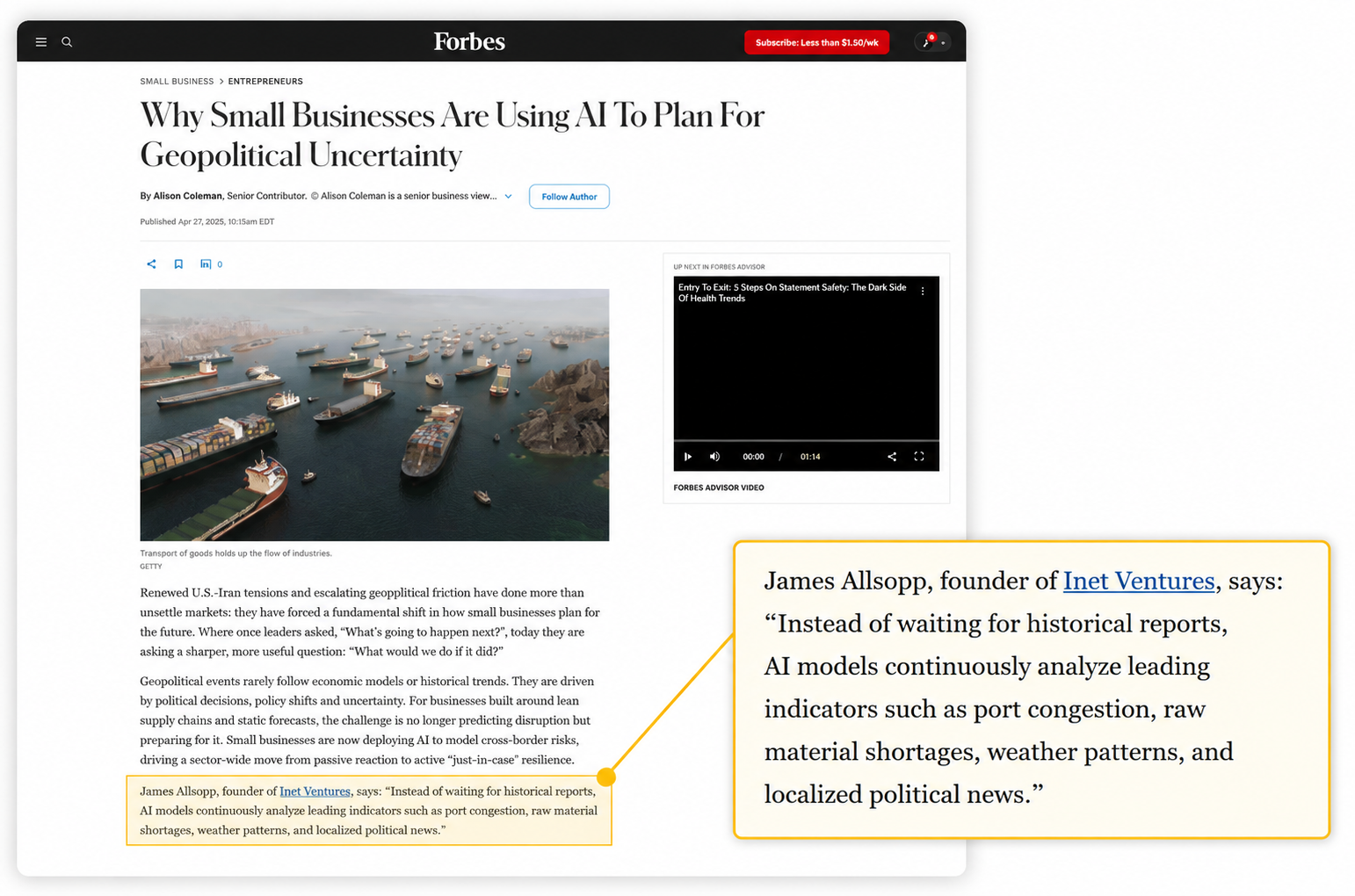
What Makes a Founder Story Interesting to Forbes?
Journalists are not looking for press releases. They are looking for stories that their readers will care about. The most common elements that make a founder story worth covering are:
What Journalists Find Interesting
- A clear problem and a non-obvious solution
- Measurable traction: revenue, users, funding, growth rate
- An unusual personal journey or contrarian decision
- Original data or research that reveals a trend
- A timely connection to a bigger story (AI, climate, remote work, a regulatory shift)
- A visual or demonstrable product
- Honesty about failures and lessons, not only successes
What Journalists Ignore
- “We launched a new website”
- “We are passionate and disruptive”
- Unverifiable claims about being the best, first or only
- Vague milestones with no numbers
- A founder who wants to review the article before publication
- A pitch that reads like a sales page
- Mass-emailed press releases with no personalisation
The test is simple: if you removed your company name from the story, would a Forbes reader still find it interesting? If the answer is no, the story is not ready yet. That does not mean you cannot get coverage—it means you should focus on building the story before pitching it.
How to Find the Right Forbes Journalist
Forbes journalists and contributors cover specific beats. Pitching a funding-round story to a journalist who covers leadership development is a waste of everyone's time. The most effective approach is to read Forbes regularly, identify the writers who cover your industry or topic, and engage with their work before you need anything.
Practical steps:
- Search Forbes for your topic. Use site search or Google with
site:forbes.com "your industry"to find recent articles. Note which writers appear repeatedly. - Read their recent work. Understand what they cover, how they frame stories and what kind of sources they quote. This tells you whether your story fits.
- Check their contact details. Most Forbes journalists and contributors list an email or social media handle on their author page or in their bio.
- Engage first. Share their work, reply thoughtfully to their posts, or send a brief note about a relevant data point without asking for anything. This is not manipulation—it is basic professional relationship-building.
- Pitch when you have something worth pitching. When you do reach out with a story, reference their previous coverage to show you have done the research.
How to Write a Pitch that Gets Read
Journalists receive hundreds of pitches a day. Most are deleted within seconds. A good pitch is short, specific and makes the journalist's job easier.
| Element | What to include | Common mistake |
|---|---|---|
| Subject line | One line that states the news, not the brand. Example: "Series B SaaS startup hits $10M ARR with zero sales team" | "Amazing new opportunity for your readers" |
| Opening | Who you are, what happened and why it matters, in three sentences | A paragraph about your company history |
| Evidence | Numbers, dates, links to verifiable sources. Offer exclusive data if you have it. | Adjectives with no substance |
| Relevance | One sentence on why this fits the journalist's beat, referencing their recent work | "I think your readers would love this" |
| Assets | Offer a headshot, product screenshots, a short bio and availability for a 15-minute call | Attach 20MB of files to the email |
| Close | A clear, low-pressure ask: "Would this be of interest? Happy to provide more detail." | "Please confirm by Friday" |
If you are not confident drafting the pitch yourself, iNet Ventures' free outreach email generator can help structure a concise first message. For broader campaign support, our digital PR service handles story development, journalist outreach and placement.
Authority Link Building
Flexible link building plans with allocation across clients. Track everything via your live dashboard.
Route 2: Forbes Contributor Articles
Forbes has a network of contributors—independent writers who publish on the Forbes platform under their own bylines. Contributors are vetted and approved by Forbes, and their work is subject to Forbes editorial guidelines, but they are not staff journalists. They choose their own topics and sources.
Getting covered by a contributor is easier than getting a staff feature, but it carries slightly less weight. A contributor article that mentions you is still valuable, but it is not the same as a staff-written editorial feature.
The process is similar to pitching a staff journalist, with one important difference: contributors are often looking for content ideas, not just stories to cover. If you can offer a contributor a strong angle, exclusive data or access to an interesting founder, you are helping them produce their next article.
Never pay a contributor for coverage. Forbes' editorial standards prohibit contributors from accepting payment for editorial coverage. Any contributor who offers to write about you for a fee is violating Forbes' policies and putting their position at risk. If discovered, the article may be removed and your brand associated with the breach.
Route 3: Forbes Councils (Paid Membership)
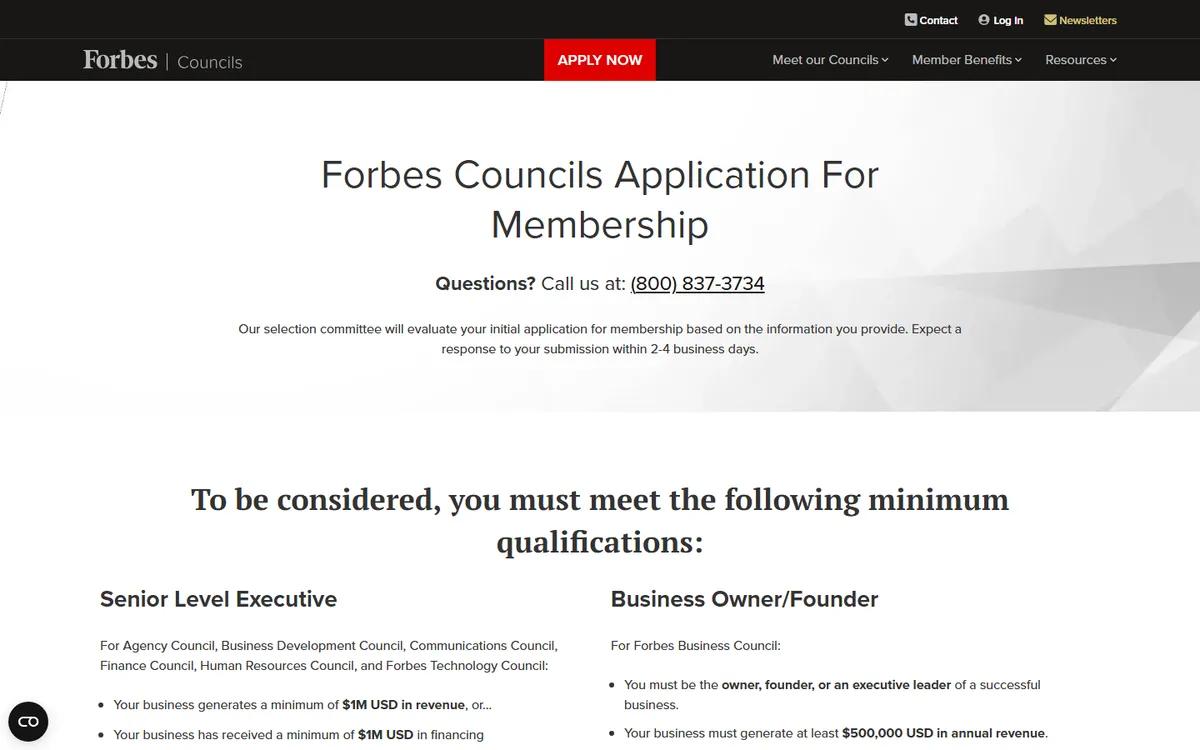
Forbes Councils is a paid membership programme that allows qualifying business owners and executives to publish articles on the Forbes platform. Members pay an annual fee, apply for admission, and if accepted, can write posts that appear on Forbes with a contributor label.
Forbes Councils posts are clearly labelled as contributor content, not editorial features. They are written by the member, not by Forbes journalists, and they do not go through the same editorial process as staff-written articles. Forbes describes Councils as a community and publishing platform for business owners, not as an editorial product.
Forbes Councils can be useful for thought leadership and content distribution. It is not the same as being featured by a Forbes journalist, and it should not be presented as such. If your goal is credibility with investors, partners or customers who understand the difference, a Councils post is a weaker signal than earned editorial coverage.
Forbes Councils is Right for You If
- You want to publish thought-leadership content on a recognised platform
- You have time to write regularly and can produce genuinely useful content
- You understand it is contributor content, not editorial coverage
- You are not using it primarily for SEO link value
Forbes Councils is Wrong for You If
- You want a Forbes journalist to write about you
- You are paying primarily for a "Forbes logo" to display on your site
- You expect it to generate significant referral traffic
- You plan to use it for followed backlinks (links are typically nofollow)
- You cannot commit to writing or reviewing content regularly
For a deeper look at the SEO implications of Forbes links—including why most Forbes outbound links are nofollow—see our companion guide Does a Forbes Mention Help SEO?
Route 4: BrandVoice and Sponsored Content

BrandVoice is Forbes' paid branded content programme. Brands pay Forbes to produce articles that appear on the Forbes platform, clearly labelled as sponsored or branded content. The content is created in collaboration with Forbes' commercial team, not the editorial team.
BrandVoice is advertising, not PR. It can be a legitimate part of a content or brand-awareness strategy, but it is not earned media and should not be described as a "Forbes feature." Forbes' own BrandVoice page describes it as a content solution for brands, not as editorial coverage.
For most early-stage founders, BrandVoice is not a sensible investment. The cost is significant—typically a five-figure minimum for a campaign—and the credibility return is lower than earned coverage because readers can see the sponsored label. It is better suited to established brands with dedicated content marketing budgets.
Route 5: Forbes Lists and Rankings
Forbes publishes several well-known lists, including 30 Under 30, the Forbes 400, the Billionaires list and various industry-specific rankings. Some are editorially curated by Forbes journalists; others accept nominations or applications.
The 30 Under 30 list, for example, has an open nomination process. Anyone can nominate themselves or someone else. Selection is made by Forbes editors and external judges. There is no fee to nominate, and payment does not influence selection.
Other lists and awards that use the Forbes brand may be operated by partners or licensees and may charge application fees. Read the terms carefully before paying. A list that charges a significant fee and accepts a high percentage of applicants is not the same signal as an editorially curated Forbes ranking.
Beware of "guaranteed Forbes features." Any service that promises guaranteed editorial coverage in Forbes for a fee is either selling something other than editorial coverage (such as a Councils post or sponsored content) or is misrepresenting what it can deliver. Forbes editorial coverage cannot be bought. If a provider cannot clearly explain which route they are using, do not engage.
Get Major Publication Links
Get featured in tier-1 media outlets like Forbes, Business Insider, and industry publications.
Building a Story that Journalists Want to Cover
The most effective thing a founder can do to improve their chances of Forbes coverage is to build a story worth covering. Pitching technique matters, but no pitch will rescue a story that is not interesting.
1. Create Original Data or Research
Journalists love data that no one else has. If you can produce original research from your business—customer behaviour trends, pricing data, industry benchmarks, survey results—you give a journalist a story angle that competitors cannot easily replicate.
This is the foundation of data-led PR. Our digital PR ideas tool can help you develop research-led campaign angles, and the broader methodology is covered in our digital PR guide.
2. Build a Contrarian or Expert Point of View
Journalists need sources with opinions, not just data. If you have a genuinely contrarian view on your industry—one backed by experience and evidence—you become a useful source for trend pieces and commentary articles. The key is that the view must be defensible and specific, not contrarian for its own sake.
This is also the basis of expert quote link building, where you offer commentary to journalists writing about your sector. See our expert quote link building guide for a detailed process.
3. Hit a Real Milestone
Funding rounds, significant revenue milestones, major customer wins, product launches and leadership hires are all legitimate news. But the bar is higher than founders often assume. A seed round is rarely newsworthy on its own; a seed round with an unusual investor, a contrarian thesis or a notable founder background might be.
Be honest with yourself about whether the milestone is interesting to a reader who does not know you. If it is not, wait until you have a stronger story rather than spending social capital on a weak pitch.
4. Connect Your Story to a Bigger Trend
Journalists write about trends. If your story illustrates a broader shift—AI adoption, remote work, sustainability, a regulatory change, a demographic shift—it becomes more useful to a journalist who is already covering that trend. The connection must be genuine, not forced.
A Realistic Timeline for Forbes Coverage
This timeline assumes you are starting from no existing journalist relationships. If you have been engaging with writers for months or years, coverage can come faster. If your story is genuinely major news—a large funding round, a significant acquisition—journalists may find you before you pitch them.
What to Do After You Are Featured
Getting the article is not the end. How you use the coverage affects its long-term value.
- Share it authentically. Post it on LinkedIn, X and your company blog with genuine commentary, not just a link. Tag the journalist (with permission).
- Add it to your press page. Create a press or media page on your website and link to the article. Use the Forbes logo only in accordance with Forbes' branding guidelines.
- Use it in sales and investor materials. A Forbes feature can open doors, but present it accurately. Do not describe a contributor post as an editorial feature.
- Track the impact. Use Google Analytics' traffic acquisition report to see referral traffic from Forbes. Use Google Search Console's branded queries filter to see whether branded search increased after publication.
- Thank the journalist. A brief, genuine thank-you note costs nothing and helps sustain the relationship for future stories.
- Do not ask for changes unless there is a factual error. Editorial coverage is the journalist's work, not yours. Requesting tone changes or additions is inappropriate; requesting correction of a factual error is reasonable.
Common Mistakes Founders Make When Pursuing Forbes Coverage
Mistakes that Waste Time
- Pitching before the story is ready
- Pitching the wrong journalist
- Sending a press release instead of a personal pitch
- Following up too aggressively
- Offering exclusives to multiple journalists at once
- Expecting control over the article
- Treating journalists as a free marketing channel
Mistakes that Damage Reputation
- Paying a contributor for coverage
- Describing a Councils post as an editorial feature
- Describing BrandVoice as "being featured in Forbes"
- Displaying the Forbes logo improperly
- Buying "guaranteed Forbes" services from unknown providers
- Misrepresenting coverage in investor materials
- Spamming multiple journalists with the same generic pitch
How Agencies Can Help with Forbes Coverage
Founders can pursue Forbes coverage directly, but many work with a digital PR agency or freelancer. A good PR partner can help identify the right journalists, develop the story, draft the pitch, manage follow-up and coordinate the assets. A bad one can damage your reputation with the very journalists you want to reach.
If you are considering working with an agency, read our companion guide for agencies: How Agencies Can Earn Mentions in Forbes, Business Insider and Entrepreneur. It covers client qualification, pitching workflows and the ethical boundaries that separate legitimate PR from paid placement.
For founders who want to understand the SEO value of a Forbes mention before investing time in pursuit of coverage, our guide Does a Forbes Mention Help SEO? covers followed versus nofollow links, referral traffic, branded search effects, entity signals and AI-search visibility.
You can also review our Forbes site profile for a summary of the publication's domain, audience and editorial characteristics.
Related Forbes Resources
- Forbes Editorial Values and Standards — Forbes' own description of how editorial and commercial content are separated
- Forbes Councils — the official membership programme for business owners and executives
- Forbes BrandVoice — Forbes' paid branded content programme
- Forbes Media Kit — advertising and partnership opportunities
Frequently Asked Questions
- Can you pay to be featured in Forbes?
- No. Forbes editorial coverage cannot be purchased. You can pay for Forbes Councils membership, which lets you publish contributor articles, or for BrandVoice sponsored content, but both are clearly labelled and are not the same as editorial coverage.
- How much does it cost to get featured in Forbes?
- Earned editorial coverage is free to pursue—there is no fee to pitch a journalist. Forbes Councils membership requires a paid annual fee set by Forbes. BrandVoice sponsored content typically starts at a five-figure budget. Avoid any service offering "guaranteed editorial coverage" for a fee.
- Is Forbes Councils worth it?
- Forbes Councils can be worth it for founders who want to publish thought-leadership content on a recognised platform and have time to write regularly. It is not worth it if the primary goal is an editorial feature, significant referral traffic or followed backlinks, because Councils posts are contributor content, not editorial.
- How long does it take to get featured in Forbes?
- From a standing start, expect three to six months to build relationships and pitch effectively. If you have a genuinely major news moment—a large funding round or significant acquisition—a journalist may cover it within days. Most coverage requires sustained relationship-building, not a single pitch.
- Do Forbes links help SEO?
- Most Forbes outbound links are marked as nofollow or sponsored, which means they do not pass direct ranking credit in the traditional sense. However, Forbes mentions can still help SEO indirectly through referral traffic, branded search, entity signals and AI-search visibility. See our dedicated guide, Does a Forbes Mention Help SEO?, for a detailed analysis.
- What is the difference between a Forbes contributor and a Forbes journalist?
- Forbes journalists are staff employees who write editorial articles. Forbes contributors are independent writers approved by Forbes who publish on the Forbes platform under their own bylines. Contributor articles are subject to Forbes guidelines but are not staff-written editorial features.
- Can I review a Forbes article before it is published?
- No. Forbes editorial articles are the journalist's work. You can request correction of factual errors after publication, but you cannot review, approve or request tone changes before publication. Any source who demands approval will not be used.
- How do I find the right Forbes journalist to pitch?
- Search Forbes for recent articles about your industry, note which writers cover the topic repeatedly, read their work to understand their angle, and engage with them before pitching. Most journalists list contact details on their author page or social media profiles.
- Is a Forbes 30 Under 30 nomination free?
- Yes. Forbes 30 Under 30 accepts open nominations at no cost. Selection is made by Forbes editors and external judges. Payment does not influence selection. Be cautious of third-party services that charge to "help" with nominations.
- Should I hire a PR agency to get Forbes coverage?
- A good PR agency can help identify journalists, develop stories and manage outreach, but no legitimate agency can guarantee editorial coverage. If an agency promises guaranteed Forbes features, ask exactly which route they use and whether the coverage is editorial or paid. Read our agency guide for more detail.
Frequently Asked Questions
Find answers to common questions about this topic


