Growth-stage technology companies face a leadership challenge that goes beyond finding qualified candidates. The real difficulty is hiring executives who stay long enough to make a difference. At a point where the business is scaling rapidly, changing its model, or preparing for investment, executive turnover carries consequences that extend far beyond the cost of a replacement search.The reasons executives leave growth-stage tech firms prematurely are well documented: misalignment between role expectations and reality, cultural friction as the organisation professionalises, and inadequate onboarding that leaves senior hires without the context they need to lead effectively. Solving for retention, therefore, has to begin before the offer is signed. It starts with how the firm thinks about recruitment.
The conditions that make growth-stage companies attractive to join are often the same conditions that create instability. Strategy shifts quickly. Priorities change. Leadership structures that worked at Series A rarely remain effective by Series C. Executives hired for one version of the business often find themselves leading a very different organisation within eighteen months.This is compounded by a mismatch in expectations. Executive candidates who come from larger, more established organisations sometimes underestimate the level of ambiguity they will encounter. Those with only startup experience may struggle when the business needs them to implement processes and governance rather than operate scrappily. Getting this fit right demands a more rigorous assessment process than most growth-stage firms currently operate.There is also the question of what executives are actually being offered. Equity structures, reporting lines, and the degree of genuine autonomy all affect whether an executive views the role as a long-term opportunity or a stepping stone. Firms that do not address these factors explicitly during recruitment tend to discover the gap at the worst possible moment.
One of the most consistent causes of executive turnover is a poorly defined role. Growth-stage tech firms often initiate searches reactively, in response to a funding event, a departure, or a gap identified by investors. The urgency of these moments can lead to job descriptions that describe an ideal rather than a reality, attracting candidates who will feel misled once they are in the seat.Firms that recruit successfully at this stage invest time before the search begins in understanding exactly what the role needs to deliver over the first twelve to twenty-four months. This means aligning the founding team, board, and investors on the specific outcomes the hire is accountable for, the resources available, and the constraints they will operate within. It also means being honest about the organisation's current maturity, the systems that exist, the gaps that do not, and the challenges that the executive will need to navigate from day one.A well-constructed role definition does not just improve the quality of candidates attracted. It filters out those who would not thrive in the specific environment, which is ultimately the most effective retention strategy available at the point of hire.
Get quoted by journalists and featured as an expert in high-authority publications.
Not every executive who looks impressive on paper will perform well inside a business that is still finding its shape. The profile required at a growth-stage technology company is distinct from what succeeds in a mature enterprise. The best candidates have typically operated across more than one stage of business development and can demonstrate that they have adapted their leadership approach as companies scaled around them.Firms should look for evidence of decision-making in conditions of incomplete information, the ability to build functions from a low base, and a track record of influencing peers and boards without relying solely on formal authority. These qualities rarely surfaced through a CV alone. They require structured interviews, reference conversations that go beyond confirmation of dates and titles, and in some cases, structured scenario-based assessments that reflect the specific challenges the hire will face.Having a deep understanding of the challenges these candidates will face is essential, which is why working with specialists who are familiar with the technology sector’s unique demands can be valuable. Specialists in executive search and recruitment in the UK who work with technology businesses understand how to identify executives with this profile. Their value lies not only in providing access to a broader candidate pool but also in their ability to assess candidates based on the firm's specific growth context. This approach focuses on the unique challenges the company is facing, rather than relying on generic leadership competencies that may not be relevant. By tailoring the search process to the company's evolving needs, these specialists ensure a better fit for both the organisation and the candidate.
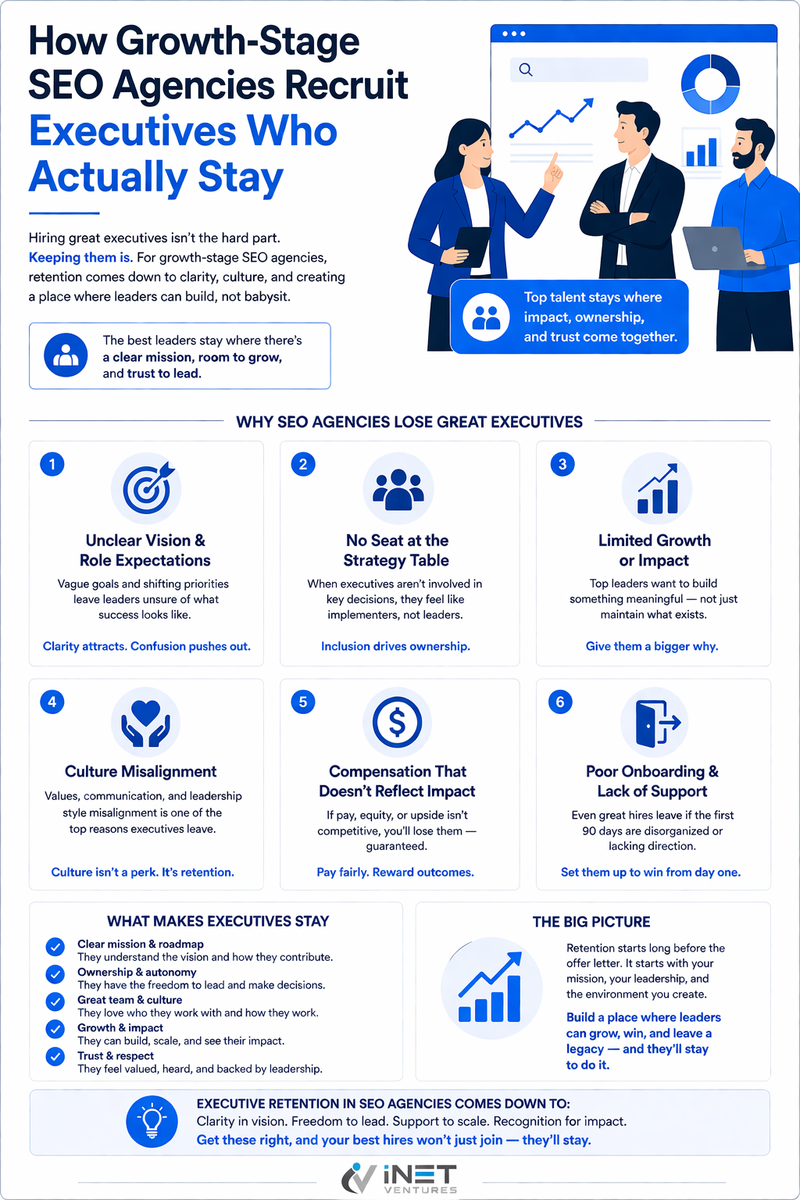
Even executives hired well can be lost within the first year if the organisation fails to support their integration. This is a particular vulnerability for growth-stage companies, where formal onboarding processes are rarely a priority, and senior leaders are often expected to make an immediate impact without adequate context.Effective executive onboarding at this stage goes beyond the first week's schedule of introductory meetings. It requires deliberate knowledge transfer about how decisions are made, who the key internal stakeholders are, where the informal power structures sit, and what the unwritten rules of the culture actually involve. Without this, executives often make early missteps that damage relationships before they have been established, creating friction that is difficult to recover from.A structured ninety-day plan, developed collaboratively between the incoming executive and the leadership team before their start date, provides a practical framework for managing this transition. It sets expectations clearly, identifies early priorities, and creates a mechanism for regular calibration between the executive and those they report to.
Compensation at growth-stage companies carries a complexity that standard salary benchmarking does not capture. Equity arrangements, vesting schedules, acceleration clauses, and the realistic probability of an exit event all shape whether an executive sees long-term commitment as financially rational. Firms that structure these arrangements poorly, or that fail to communicate them clearly during the recruitment process, create conditions for departure the moment a more transparent opportunity appears.The right approach is to design compensation packages that reward sustained contribution rather than just tenure. Performance conditions tied to specific milestones, equity that vests meaningfully over a realistic timeframe, and clarity about how the value of that equity might be realised all send a signal to the incoming executive that the organisation is genuinely invested in the relationship.This conversation should happen openly during the recruitment process, not after the offer has been accepted. Executives who understand clearly what they are joining, what they stand to gain from staying, and how their contribution will be measured are materially more likely to make the long-term commitment the company needs.
Recruiting executives who stay is not a single-step problem. It requires rigour in role definition, precision in candidate assessment, investment in onboarding, and compensation structures designed to sustain rather than simply attract. Growth-stage technology companies that treat executive recruitment as a strategic discipline, rather than a reactive exercise, are the ones best positioned to build the leadership teams that carry them through the periods of change that define this stage of growth. The cost of getting it wrong is significant. The investment required to get it right is considerably smaller.
Ready To Get Started?
Join thousands of agencies who trust iNet Ventures for their link building needs.
Create AccountRelated Articles
Continue exploring our latest insights and strategies for digital marketing success.