
X—still commonly called Twitter—remains one of the world’s most active platforms for real-time news, opinions, entertainment, professional networking and public conversation.
Hootsuite reports that X has approximately 611 million monthly active users, while users watched around 8.3 billion videos per day during 2024—a 40% year-on-year increase. Its benchmarks also place average organic engagement at approximately 1.6%, although performance varies considerably by industry and account size. Hootsuite’s X statistics
That gives creators and businesses an enormous potential audience. It does not, however, make attracting followers easy.
There is no magic trick that will turn a new account into an influential one overnight. Sustainable growth comes from repeatedly publishing worthwhile content, contributing to relevant conversations and giving people a clear reason to follow you.
The following 30 strategies explain how to increase your X followers organically in 2026—without buying followers, using engagement schemes or turning your account into an automated content machine.
Does X still matter in 2026?
X is no longer the only major platform for public text-based conversation. Threads, Bluesky, LinkedIn, Reddit and decentralised networks now compete for similar audiences.
That does not mean you should abandon X. It means you should decide whether the platform fits your particular audience, goals and style.
X remains particularly useful for:
- Breaking news and live events
- Technology, gaming, finance and politics
- Founder and professional networking
- Journalism and expert commentary
- Sports, television and entertainment
- Customer support and brand announcements
- Joining public conversations with industry specialists
Before investing heavily in the platform, consider which social networks best suit your audience. Being consistently useful on two relevant platforms is normally more productive than maintaining weak accounts on six.
X follower growth statistics to know
These figures provide some useful context:
| Statistic | What it means |
|---|---|
| X has approximately 611 million monthly active users | The potential audience remains substantial |
| Users watched 8.3 billion videos per day during 2024 | Native video deserves a place in your content testing |
| Overall organic engagement averages approximately 1.6% | Smaller engagement numbers are not automatically evidence of failure |
| Average weekly follower growth is approximately 0.11% | Organic growth is usually gradual rather than explosive |
| Consistent posters received up to five times more engagement per post | A sustainable routine matters more than occasional bursts |
The first four figures come from Hootsuite’s published X benchmarks. The consistency figure comes from Buffer’s analysis of more than 100,000 accounts across supported social networks. Buffer’s consistency study
These are broad benchmarks rather than promises. Your own audience data should always take priority over a universal average.
1. Decide exactly why someone should follow you
Before changing your posting schedule, define what followers will receive from your account.
A useful positioning statement follows this structure:
I help [audience] understand or achieve [result] by sharing [type of content].
Examples include:
- Daily explanations of important AI developments
- Practical SEO observations from real campaigns
- Reliable gaming deals without irrelevant promotions
- First-hand commentary from within a particular industry
- Simple personal-finance lessons for UK freelancers
“Business, technology and things I find interesting” is too broad. A stranger should be able to understand your value within a few seconds.
This does not mean you can never post outside your niche. It means your account needs a recognisable centre of gravity.
2. Optimise your X profile for follower conversion
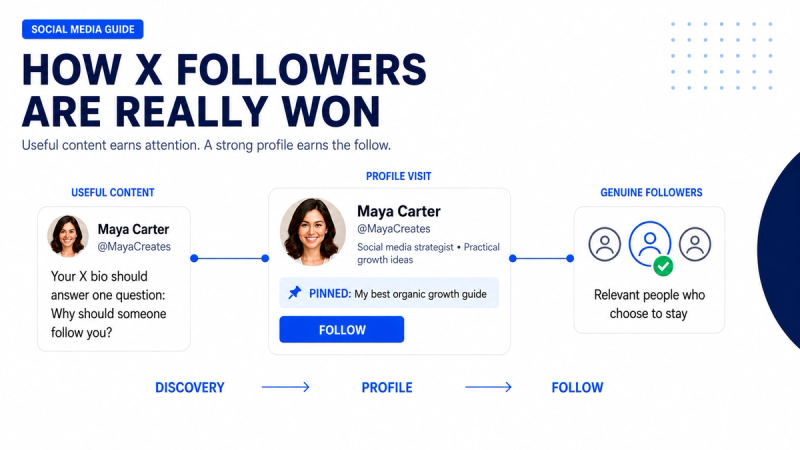
Reaching people is only half the challenge. Your profile must convert those visitors into followers.
An incomplete or confusing profile is a reliable way to keep your follower count low. Include:
- A clear, recognisable profile picture
- A banner that reinforces your subject or brand
- A concise name and relevant handle
- A bio explaining what you post and who it helps
- A relevant location, where appropriate
- One purposeful external link
- A strong pinned post
Your biography should describe the value of following you—not merely list vague adjectives such as “entrepreneur”, “visionary” or “thought leader”.
Profile optimisation works across platforms. Many of the principles in our guide to optimising a LinkedIn profile also apply to X: clarity, topical relevance, recognisable branding and evidence of expertise all help people decide whether you are worth following.
3. Use a consistent profile identity
Try to use the same or a clearly related profile picture, display name and visual identity across your main social accounts.
Consistency makes you easier to recognise when an existing reader, customer or follower encounters you elsewhere. A corporate LinkedIn profile may need a more formal image, but it should still be recognisably connected to the same person or business.
Do not frequently change your handle without a compelling reason. Links, mentions and people’s memories may all point towards the previous identity.
4. Create three to five content pillars
Content pillars are the recurring subjects around which you build your account.
An SEO specialist might choose:
- Practical link-building advice
- Industry news and algorithm changes
- Campaign observations
- Tools and workflow recommendations
- Personal lessons from running an agency
A gaming account might concentrate on news, discounts, reviews, retro discoveries and industry commentary.
Pillars prevent your account from becoming random while still allowing enough variety to keep it interesting. They also help you plan content more efficiently.
If you are developing an individual rather than a corporate profile, our guide explaining what a digital creator is provides useful background on combining expertise, presentation and audience expectations.
Analyze Your Backlink Profile
Get detailed insights into your backlink quality with Moz, Ahrefs & Majestic data combined.
5. Publish original information
Original information is one of the strongest reasons to follow someone.
You do not need to conduct a national survey every week. Originality can come from:
- First-hand experience
- A screenshot from your own analytics
- An observation from a current project
- A small experiment
- A useful comparison
- A photograph from an event
- A chart created from public data
- A mistake and what it taught you
- A reasoned opinion that differs from the consensus
Hundreds of accounts can repeat the same news. Fewer can explain what it means, test whether a claim is true or add knowledge that was not already available.
Gary Vaynerchuk summarised the distinction well:
“They should be putting out information, not commercials.”
His wider point is that every organisation now has the ability to operate like a media company. Gary Vaynerchuk’s content guidance
You do not need to follow his extreme publishing-volume recommendation. The valuable principle is to provide information rather than filling your feed with advertisements.
6. Post consistently, not constantly
The previous version of this guide recommended posting “as often as possible”. That is too simplistic.
Frequency helps only while the content remains worthwhile. Five repetitive or low-effort posts can weaken an account more than one strong post can help it.
Start with a schedule you can maintain for at least eight weeks. For many individuals and smaller businesses, that could mean:
- One or two original posts per weekday
- Several thoughtful replies
- One thread or substantial post each week
- One video, visual or data-led post each week
Buffer senior content writer Kirsti Lang explains:
“From our research and experience at Buffer, there’s only one thing that comes close: posting consistently.”
Buffer’s study found that highly consistent accounts received around five times more engagement per post than inconsistent accounts. Importantly, the study measured regular weekly activity—not an obligation to post dozens of times every day.
7. Write stronger opening lines
The opening line determines whether someone continues reading.
Avoid empty introductions such as:
- “Some thoughts on marketing…”
- “Here is a thread…”
- “I don’t know who needs to hear this…”
- “This may be controversial…”
Lead with the insight, result, question or tension instead:
- “We analysed 500 unsuccessful outreach emails. Three mistakes appeared repeatedly.”
- “Most accounts do not have a reach problem. They have a profile-conversion problem.”
- “I stopped using hashtags for 30 days. Here is what actually changed.”
- “This campaign attracted fewer impressions but three times as many qualified enquiries.”
A good hook creates curiosity without misleading the reader. Do not promise a dramatic revelation and deliver an obvious observation.
8. Make each post easy to understand
A post can contain an excellent idea and still fail because it takes too much effort to interpret.
Before publishing, ask:
- Is the central point obvious?
- Can I remove unnecessary words?
- Have I introduced unexplained jargon?
- Is the formatting readable on a phone?
- Does the post need supporting context?
- Can the claim be misunderstood?
- Have I made the takeaway useful?
Short paragraphs and deliberate line breaks can improve readability, but do not split every sentence purely to imitate an “influencer” template.
9. Use images, charts and video purposefully
Visual content remains important, but adding an unrelated stock image will not automatically increase engagement.
Use media when it adds information or makes the post easier to understand:
- Original photographs
- Product demonstrations
- Before-and-after comparisons
- Data visualisations
- Screenshots with sensitive details removed
- Short explanatory videos
- Infographics
- Event footage
- Charts showing a real result
The reported 8.3 billion daily video views on X demonstrate the scale of video consumption, but the best format still depends on your audience.
Add captions to spoken video and descriptive alt text to important images. Accessibility improves the content for users with disabilities and for people watching without sound.
10. Become valuable in other people’s replies
You do not need a large existing audience to publish a useful reply beneath a relevant post.
Look for conversations where you can contribute:
- A missing example
- First-hand experience
- A polite correction
- Additional evidence
- A concise answer
- A genuinely useful resource
- A thoughtful counterargument
Avoid generic replies such as “Great post”, “So true” or “This is the way”. They add nothing and can make the account resemble a growth bot.
Do not hijack popular posts with unrelated self-promotion. X’s rules prohibit aggressive or irrelevant replies intended to drive attention towards an account, product or website.
11. Reply to people who engage with you
When people leave meaningful replies, acknowledge them.
You do not have to answer every emoji or repeat the same “thank you” hundreds of times. Focus on interactions where you can extend the discussion, answer a question or show genuine appreciation.
Ash Read, Buffer’s former head of content, offers a useful reminder:
“Conversations usually come to a natural end point and not every reply will need a response.”
His guide to handling social-media conversations also recommends responding promptly to genuine questions while recognising that trolls often want attention rather than a resolution.
12. Use quote posts to add something new
A quote post should explain why the original matters.
Useful additions include:
- Your interpretation
- Agreement with supporting evidence
- Respectful disagreement
- An example from another industry
- The practical implication
- A prediction
- A concise summary for your audience
Do not simply write “This” above someone else’s content. If the original post already communicates everything necessary, a normal repost may be more appropriate.
Authority Link Building
Monthly retainer combining Blogger Outreach, Link Insert and Digital PR placements. Track everything via your live dashboard.
13. Repost selectively
Your X profile is more than a repository for your own thoughts. It can also curate excellent information from elsewhere.
However, if nearly everything on your profile comes from other people, visitors have little reason to follow you specifically.
A healthy feed might combine:
- Original posts
- Replies
- Quote posts with commentary
- Carefully selected reposts
- Occasional promotional content
Curating good material can build trust, but your own expertise and personality must remain visible.
14. Use threads when the subject genuinely needs one
Threads remain useful for:
- Step-by-step explanations
- Event reporting
- Case studies
- Timelines
- Research summaries
- Detailed comparisons
- Lessons from a project
The first post must make a clear promise. Subsequent posts should each advance the explanation rather than restating the same point.
Numbering can help readers navigate longer threads. End with a concise summary or action—not a desperate request for likes and reposts.
If your content is better suited to another text-focused platform, compare how you present it there. Our guide to using Threads as an influencer explores the value of adapting content instead of treating every network identically.
15. Comment on relevant news quickly—but carefully
X remains valuable for real-time conversation. If important news breaks within your field, publish your interpretation while people are actively discussing it.
Speed must not replace accuracy. Before posting:
- Check the original source
- Confirm the date and context
- Distinguish confirmed facts from reports
- Credit whoever discovered the information
- Correct mistakes transparently
- Avoid presenting speculation as certainty
Being first can earn attention. Being reliably correct builds an audience.
16. Do not spread misinformation
This principle from the original guide remains essential.
However tempted you may be to spread an exciting but unverified claim, do not sacrifice trust for a temporary increase in reach. Misleading information can damage your reputation long after the original post disappears from public attention.
The same applies to deceptively edited and AI-generated media. Label synthetic material where people could otherwise mistake it for a genuine event, recording or statement.
Our guide to maintaining content integrity when using automation explains why human review remains necessary even when AI helps with research, drafting or repurposing.
17. Use trends only when you have something relevant to contribute
Trending topics can expose your account to a larger conversation, but forcing every trend into your content usually looks desperate.
Before joining one, ask:
- Is the subject genuinely connected to my expertise or audience?
- Do I have an original observation?
- Can I add evidence, humour or practical value?
- Could participation create an avoidable reputational risk?
- Have I understood why the topic is trending?
Our collection of social-media campaign lessons includes the same enduring principle: use timely topics, but remain relevant.
18. Treat hashtags as labels, not a growth strategy
Hashtags still have uses, particularly for:
- Conferences
- Campaigns
- Regular events
- Community discussions
- Television and sports coverage
- Public-awareness initiatives
They are no longer something that must be added to every post.
Use a hashtag when it helps someone understand or find the conversation. Avoid adding a block of loosely connected popular terms.
X specifically prohibits using unrelated trending hashtags to manipulate a conversation, alongside excessive hashtags, duplicated content and artificial engagement. Its policy states:
“You may not engage in inauthentic activity that undermines the integrity of X.”
Read the X authenticity and platform-manipulation policy before using bulk automation or any supposed growth service.
19. Never buy followers or artificial engagement
The old recommendation to consider an “organic” follower service should be removed completely.
Services promising guaranteed followers, likes, views or reposts commonly rely on bots, compromised accounts, incentives or coordinated engagement. Even when the numbers remain on your profile, they usually provide no genuine audience value.
Artificial followers can:
- Distort your analytics
- Lower the percentage of followers who engage
- Reduce your credibility
- Waste future advertising spend
- Make partnership decisions harder
- Expose your account to enforcement
X prohibits paying others to inflate follows, views, likes, replies or reposts. It also prohibits follow churn and coordinated engagement exchanges.
One hundred interested followers are more valuable than 10,000 accounts that never read, recommend or purchase anything.
20. Avoid engagement pods and follow-for-follow schemes
Engagement groups create the appearance of popularity without necessarily creating influence.
The participants may like and repost one another, but they are acting from obligation rather than genuine interest. That makes the resulting data largely useless.
Follow-for-follow has similar problems. It creates an audience based on reciprocity instead of relevance and can become prohibited follow churn when people repeatedly follow and unfollow accounts to inflate their numbers.
Build relationships with peers, but allow engagement to happen naturally.
21. Join relevant X Communities
Communities provide focused spaces for discussions around industries, hobbies, locations and shared interests.
Do not enter a Community and immediately promote yourself. Spend time understanding its rules and established tone. Answer questions, contribute useful information and recognise regular participants.
X explains that Community posts can appear on Community pages, profiles, search results and other timelines. That gives strong contributions a chance to travel beyond the immediate group. X’s Communities guide
The goal is not to extract followers from the Community. It is to become a recognisably useful participant whom people independently choose to follow.
Build E-E-A-T Authority
Expert quotes via Digital PR — your spokesperson quoted in DR 50+ publications.
22. Participate in or host X Spaces
Spaces allow people to host public live-audio discussions.
They can help you demonstrate expertise in a way that a short post cannot. Possible formats include:
- Interviews
- Industry-news discussions
- Live Q&As
- Weekly panels
- Event reactions
- Product feedback sessions
- Informal conversations with creators
Start by speaking in established Spaces before hosting your own. When you host, give the event a specific title and invite people who bring complementary knowledge rather than assembling a panel of identical opinions.
Turn the strongest moments into follow-up posts, clips or summaries.
23. Build relationships with creators in your niche
Following people within your niche remains sensible, but not because you expect them to follow you back.
Identify researchers, journalists, founders, creators, customers and knowledgeable enthusiasts. Engage with their work over time. Share it when it deserves attention and contribute when you have something useful to add.
Do not immediately ask for a repost, introduction or collaboration.
Relationships develop through repeated positive interactions. Our guide to influencers and digital marketing explains why audience relevance and trust matter more than headline follower numbers.
24. Collaborate to reach adjacent audiences
Once you have established genuine relationships, consider:
- Co-hosting a Space
- Interviewing another specialist
- Creating a joint guide
- Exchanging expert commentary
- Running a research project
- Comparing different professional approaches
- Covering an event together
The ideal collaborator serves an audience that overlaps with yours without being identical.
If money, products or another benefit changes hands, disclose the commercial relationship clearly. Our guide for people who want to become an influencer also covers the importance of branding, commitments and disclosure.
25. Cross-promote your X account elsewhere
People who already value your work are the easiest prospective followers to reach.
Add your X profile where appropriate:
- Website author biography
- Email signature
- Newsletter
- YouTube channel
- Podcast notes
- LinkedIn profile
- Instagram or TikTok bio
- Event speaker profile
- Other owned communities
Give people a reason to move platforms. Instead of merely saying “Follow us on X”, explain what is available there: breaking updates, live commentary, deals, support or daily observations.
A broader business social-media presence works best when each platform performs a recognisable role.
26. Pin a post that converts visitors
Your pinned post is one of the first pieces of content a profile visitor sees.
Good options include:
- An introduction to you and your work
- Your strongest evergreen guide
- An original research project
- A case study
- A successful thread
- A current product or newsletter
- A regularly updated directory of your best content
Do not leave an outdated promotion pinned for years. Review it every month and replace it when a stronger representation of your account becomes available.
27. Promote offers without overwhelming your audience
Offers and discounts can attract loyal followers when they are central to your niche. Deal-focused accounts such as Wario64 have grown by becoming reliable sources of timely, relevant savings.
Trust is the key. Confirm the price, indicate regional restrictions, disclose affiliate relationships and remove or update expired information where practical.
For other accounts, promotional posts should form only part of the content mix. Provide sufficient insight and entertainment before asking people to buy, subscribe or book.
Gary Vaynerchuk puts the underlying attention challenge succinctly:
“Attention is the singular asset.”
Earning that attention requires repeated value. Demanding it through constant promotion does not.
28. Use analytics to find what converts followers
Impressions do not tell the whole story.
Review performance weekly and record:
- Impressions
- Likes
- Replies
- Reposts
- Bookmarks
- Video completion
- Link clicks
- Profile visits
- Followers gained
- Unfollows
- Enquiries, sign-ups or sales
The most useful follower-growth calculation is:
Follower conversion rate = new followers ÷ profile visits × 100
For example, 40 new followers from 800 profile visits produces a 5% profile-visit-to-follow conversion rate.
This helps separate two different problems:
- Low profile visits suggest that your content is not generating enough curiosity.
- High profile visits but few follows suggest that your positioning, biography, pinned post or recent content is not convincing.
Hootsuite’s Christina Newberry advises:
“Smart marketers will keep an eye on their metrics in X analytics.”
Analyse patterns across several weeks. One viral post can distort a short reporting period.
29. Test timing using your own audience
There is no single best time to post for every account.
A UK business audience, US gaming community and global cryptocurrency audience will naturally behave differently. News and live events can also make normal scheduling irrelevant.
Test several time windows and compare performance over at least four weeks. Look beyond impressions: a time that generates fewer views but more relevant replies or conversions may be better.
Scheduling tools can help maintain consistency, but remain available for replies. Scheduled posts can also appear insensitive if unexpected breaking news changes the context, so pause them when necessary.
30. Keep going—and improve deliberately
Organic follower growth is rarely smooth. You may gain followers quickly after one successful post and then see little movement for several days.
Hootsuite’s benchmark of approximately 0.11% average weekly follower growth shows why patience matters. A modest percentage can still compound into a valuable audience when the followers are relevant and engaged.
Do not repeat the same approach indefinitely and call it persistence. Review what worked, identify what failed and make a controlled change.
Every month, ask:
- Which topics created the most profile visits?
- Which posts converted visitors into followers?
- Which formats generated worthwhile conversations?
- What caused unfollows?
- Which posts produced business results?
- What should be repeated, improved or dropped?
Persistence works when it is combined with learning.
A practical 30-day X growth plan
Week one: Build the foundation
- Define your intended audience.
- Choose three to five content pillars.
- Rewrite your biography.
- Update your profile and banner images.
- Add one purposeful link.
- Create a strong pinned post.
- Identify 25 relevant accounts and five Communities.
- Record your starting follower and engagement figures.
Week two: Establish consistency
- Publish at least five original posts.
- Test one image or chart.
- Publish one short video.
- Leave five meaningful replies each day.
- Reply to genuine engagement on your posts.
- Test two different publishing times.
- Save promising questions and discussions as future content ideas.
Week three: Create an authority asset
Produce one substantial piece of content:
- A detailed thread
- Original data
- A case study
- A useful template
- A first-hand comparison
- An expert interview
Support it with several smaller posts that approach the same subject from different angles. Do not duplicate the same wording.
Week four: Analyse and refine
Compare:
- Original posts versus replies
- Text versus media
- Different topics
- Different publishing times
- Impressions versus profile visits
- Profile visits versus follows
- Traffic and conversions
Choose the best-performing subjects and formats for the following month. Remove tactics that produced empty engagement without relevant followers or results.
What not to do when trying to grow on X
Avoid:
- Buying followers
- Paying for artificial engagement
- Joining engagement pods
- Mass following and unfollowing
- Posting irrelevant links under popular accounts
- Reusing the same reply repeatedly
- Filling posts with unrelated hashtags
- Copying other creators
- Publishing unverified news
- Using fabricated expert quotations
- Hiding sponsorships or affiliate relationships
- Allowing AI to post unsupervised
- Picking unnecessary public arguments
- Measuring success through follower count alone
These tactics may create short-term numbers, but they rarely build a valuable audience.
Frequently asked questions
How often should I post on X in 2026?
Start with one or two worthwhile original posts on most weekdays, supported by genuine replies. Increase the frequency only if you can maintain quality.
Consistency matters more than hitting an arbitrary daily quota.
How long does it take to gain followers on X?
There is no standard timeframe. Your starting network, niche, experience, content quality and participation in current conversations all affect growth.
Evaluate progress across months rather than expecting meaningful conclusions from a few days.
Do hashtags still increase reach on X?
They can help within events, campaigns and established community conversations, but they are not required on every post. Use only clearly relevant hashtags and avoid unrelated trending terms.
Should I pay for X Premium to gain followers?
Premium may provide features that are useful to some creators and businesses, but paying for a subscription does not make weak content valuable.
Consider it for the features you genuinely need—not as a guaranteed growth shortcut.
Do links reduce reach on X?
Do not assume that every external link will automatically fail. Test link posts against native summaries and track actual clicks and conversions.
If the destination is important, explain why someone should visit it rather than publishing a bare URL.
Are threads still useful?
Yes, when the subject requires multiple connected posts. Do not stretch a simple observation into a long thread merely because the format once performed well.
Can AI help me grow an X account?
AI can help brainstorm subjects, repurpose existing work, check clarity, create draft schedules and summarise analytics.
It should not replace first-hand expertise, fact-checking or human interaction. Review every post before publication and do not use AI to manufacture experiences or imitate another person.
Should I delete posts that perform badly?
Usually not. A low-performing post is data, not necessarily an embarrassment. Delete content when it is incorrect, harmful, outdated in a dangerous way or accidentally reveals information—not merely because it received few likes.
Is it worth promoting posts?
Paid promotion can help a business reach a precisely defined audience, but it should support a proven objective such as registrations, leads or sales.
Do not spend money simply to make the visible follower count larger. Test the content organically first and measure commercial outcomes.
What is the most important X growth metric?
Follower count is useful, but follower quality matters more.
Track whether the account attracts relevant people, generates conversations, drives profile visits, sends useful website traffic and contributes to enquiries, subscriptions or sales.
Final thoughts
Growing on X in 2026 is not about discovering a hidden algorithm trick. It is about becoming consistently useful, recognisable and trustworthy within a particular set of conversations.
Optimise your profile, publish original information, make thoughtful contributions beneath other people’s posts and analyse which content turns attention into lasting interest.
Most importantly, resist shortcuts. Bought followers, copied content and artificial engagement may make an account look larger, but they do not create influence.
Build an audience that genuinely wants to hear from you. That audience may grow more slowly—but it will be considerably more valuable.

James is the founder and CEO of iNet Ventures, bringing over two decades of experience in SEO, link building, and online growth. He has helped online agencies scale through white-label solutions and has overseen the delivery of 25,000+ links, combining proven strategies with AI-driven workflows to drive efficient, long-term results.
View More Posts

