A logarithmic scale compresses massive differences into readable data — and it completely changes how you should think about link building and Domain Rating. Learn what it means and why your DR30 to DR50 jump is harder than it looks.
Most people approach SEO with a simple expectation: effort in, results out.
Build a few links, rankings go up. Build more links, rankings go up more. It feels logical—almost mechanical.
But that’s not how search engines work.
SEO growth is uneven. It stalls, accelerates, compounds, and sometimes surprises you. You can spend months building links with little visible progress, only to see rankings suddenly shift all at once. That pattern isn’t random—it’s the result of something deeper.
SEO behaves much closer to a logarithmic system, not a linear one.
And once you understand that, everything—from link building strategy to expectations—starts to make a lot more sense.
A logarithmic scale measures growth in multiplicative steps rather than additive ones.
Instead of increasing by the same amount each time, values increase by factors—often by 10x, 100x, or more. This allows very large differences to be represented in a compressed way.
In practical terms, moving from 10 to 100 is treated similarly to moving from 100 to 1,000—even though the actual increase is much larger. Each step represents a significant leap in scale.
This concept appears in many real-world systems, including finance, physics, and importantly, how search engines interpret authority and trust.
If you're unfamiliar with core SEO terminology around this, it’s worth reviewing foundational definitions in a structured SEO glossary, as many ranking concepts tie back to this idea.
SEO feels like it should reward effort evenly. But Google doesn’t rank pages based on effort—it ranks them based on relative authority within an ecosystem.
That ecosystem behaves logarithmically.
Early on, your website has very little authority. You can build links, optimise content, and still see minimal movement. This isn’t because your work isn’t effective—it’s because you’re operating at the lowest end of the curve.
Then something shifts.
As authority builds, each additional link has more impact. Pages rank faster. Content performs better. Internal links start passing meaningful value across your site.
You’re no longer pushing uphill—you’re gaining leverage.
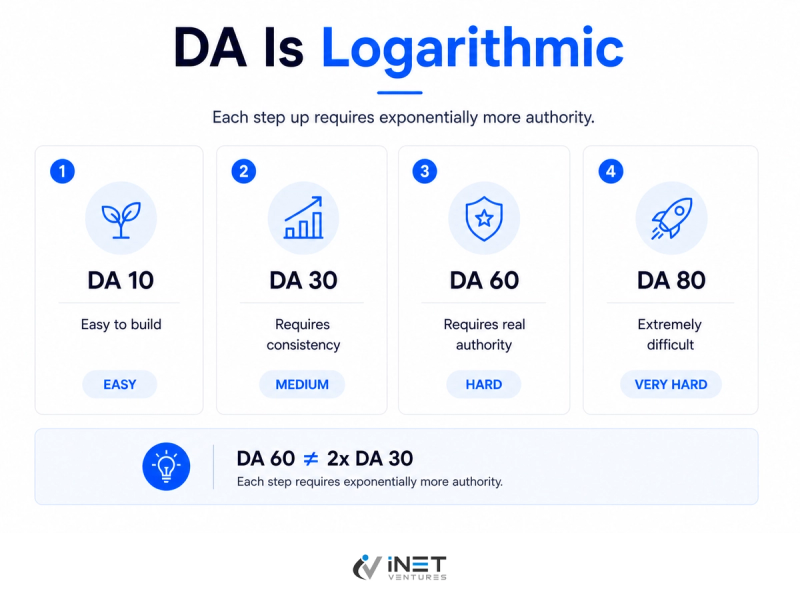
Metrics like Domain Authority (Moz) and Domain Rating (Ahrefs) are widely used in SEO, but many people misunderstand how they work.
They’re not linear scores.
They operate on a logarithmic scale, which means the effort required to increase your score grows significantly as you move up.
A study by Ahrefs found that 90.63% of pages get no organic traffic from Google . One of the biggest reasons is lack of backlinks and authority—highlighting how difficult it is to move out of the lower end of the curve.
Going from a low authority score to a moderate one might require a handful of solid links.
But pushing into higher ranges—where competitive rankings happen—requires sustained, high-quality link acquisition and strong site-wide trust signals.
If you’re struggling with this stage, understanding why your domain authority is low can provide useful context.
Get quoted by journalists and featured as an expert in high-authority publications.
When you apply logarithmic thinking to link building, the strategy becomes clearer.
In the early stages, you’re building a foundation. Progress feels slow because each link contributes only a small amount of relative authority.
But that doesn’t mean it’s ineffective.
Over time, links begin to stack. Authority compounds. Pages benefit not just from direct links, but from the overall strength of the domain.
Eventually, you reach a point where each new link contributes more than the last—not because it’s stronger, but because your site is.
This is why structured approaches to link building focus on consistency and quality rather than short bursts of activity.
Not all backlinks are equal—and this becomes obvious when viewed through a logarithmic framework.
A large number of low-quality links might produce minimal impact.
Meanwhile, a single strong backlink from a trusted, relevant site can significantly influence rankings.
According to a study by Backlinko, the number one result in Google has an average of 3.8x more backlinks than positions #2–#10 . But more importantly, those links tend to come from higher-authority domains.
It’s not just quantity—it’s where those links sit on the authority scale.
Understanding what makes a high-quality backlink is essential if you want to move up that curve efficiently.
This is where most websites struggle.
You’re building links, publishing content, and doing the right things—but results are minimal. Growth feels flat, and it’s easy to assume something isn’t working.
In reality, you’re simply at the bottom of the curve.
Gradually, things begin to shift.
Pages start ranking more easily. Links carry more weight. Internal structure begins amplifying your efforts.
You’re no longer starting from zero—you’re building on accumulated authority.
At higher levels, growth becomes noticeably faster.
Content gains traction quickly. Rankings improve with fewer links. Authority flows naturally across your site.
This is where SEO starts to feel powerful—but it only happens if you’ve pushed through the earlier stages.
The issue isn’t usually strategy—it’s expectation.
Many campaigns are built on the assumption that results should scale evenly with effort. When that doesn’t happen, confidence drops.
Budgets get reduced. Campaigns are paused.
But in many cases, the work was effective—it just hadn’t reached the point where results compound.
When you approach SEO with a logarithmic mindset, your strategy changes.
You stop chasing quick wins and start building momentum. You focus on authority rather than volume. You prioritise consistency over short-term spikes.
You also begin to use tools and data more effectively—whether that’s analysing backlink profiles, tracking authority growth, or identifying opportunities through platforms like the iNet Ventures tools section.
Most importantly, you understand that progress isn’t always visible immediately—but it is happening.
SEO isn’t linear.
It’s a system built on compounding authority, where early effort lays the groundwork and later effort unlocks exponential results.
That’s why some sites suddenly take off. That’s why others stall. And that’s why link building—done properly—is still one of the most powerful ranking factors in search.
Once you understand the curve, you stop guessing.
And you start building with intent.
Explore services, view pricing and manage campaigns in one place.
No subscription required • 100% white-label
Related Articles
Continue exploring our latest insights and strategies for digital marketing success.