What authority backlinks are, why DR alone does not make a link valuable, six signals to check before pitching, eight practical ways to earn them and how to measure results.
 James Allsopp
A backlink from a famous website might look impressive in an SEO report. But what if that link appears in an unrelated article that nobody reads? Meanwhile, a smaller, specialist publication might send qualified visitors and introduce your brand to exactly the audience you want to reach.
That distinction is at the heart of authority backlinks. The strongest link-building strategies in 2027 should not revolve around collecting the highest Domain Rating (DR) numbers. They should focus on earning relevant references from credible publishers, researchers, industry organisations and genuinely useful websites.
This guide explains how to recognise a valuable backlink, where to find opportunities, how to approach publishers and what to measure after a link goes live.
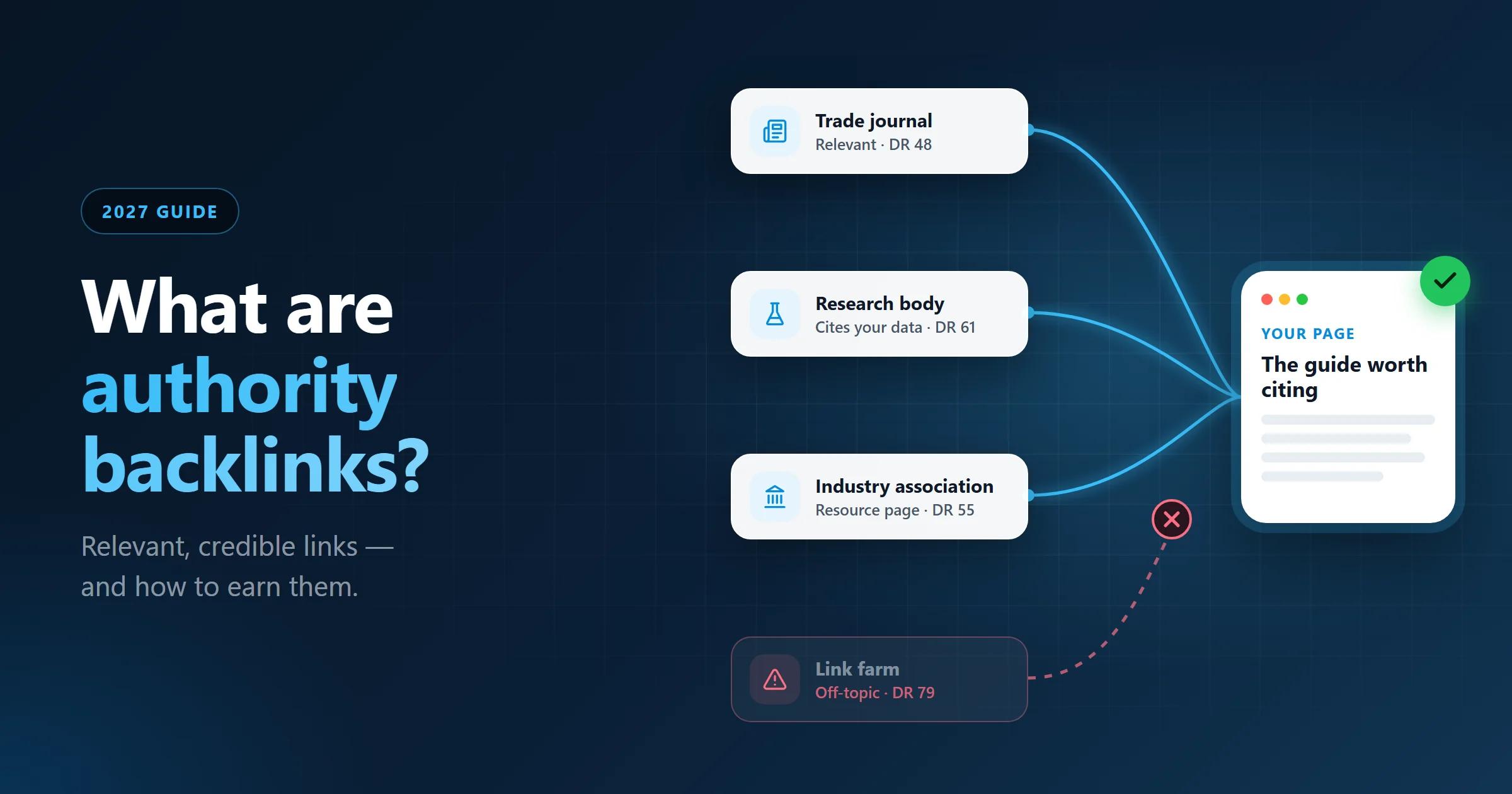
An authority backlink is a link to your website from another page that is credible, relevant and useful to its audience. It is typically included because the publisher believes your content offers evidence, an explanation, a tool or additional information worth recommending.
For example, a respected home renovation magazine linking to a lighting retailer's guide on choosing LED colour temperatures is a potentially valuable, contextually relevant citation. A random link from a high-DR site publishing unrelated finance, gaming and home-improvement adverts every day is a different proposition.
The word authority describes the quality and trustworthiness of the source; it is not a formal Google backlink category or a score supplied by Google. Link analysis is one part of search, but Google also considers many other signals. Its SEO Starter Guide explains why useful content, descriptive links and discoverability matter.
Every authority backlink is a backlink, but not every backlink deserves to be called authoritative.
| Factor | Strong authority backlink | Weak or questionable backlink |
|---|---|---|
| Topical connection | The linking article closely relates to your subject | The surrounding content is unrelated |
| Publisher | Recognisable expertise, editorial standards and real readers | Anonymous, thin or largely promotional website |
| Reason for linking | Your page supports a claim or helps the reader | The link appears solely to target a keyword |
| Placement | Naturally embedded in useful body content | Crowded footer, irrelevant paragraph or boilerplate |
| Audience | Readers could realistically visit or use your page | Little genuine audience overlap |
| Risk | Editorially justified and transparently disclosed where relevant | Part of an artificial or undisclosed ranking-link scheme |
A useful test: Would this link still make sense if search engines did not exist? If the answer is no, investigate further before pursuing it.
Not necessarily. DR is Ahrefs' proprietary 0–100 measurement of the relative strength of a website's backlink profile. Moz's Domain Authority and Semrush's Authority Score are different third-party metrics. None is Google's own ranking score. Ahrefs itself cautions against judging a site solely by DR; see its official DR explanation and our guide to DA vs DR.
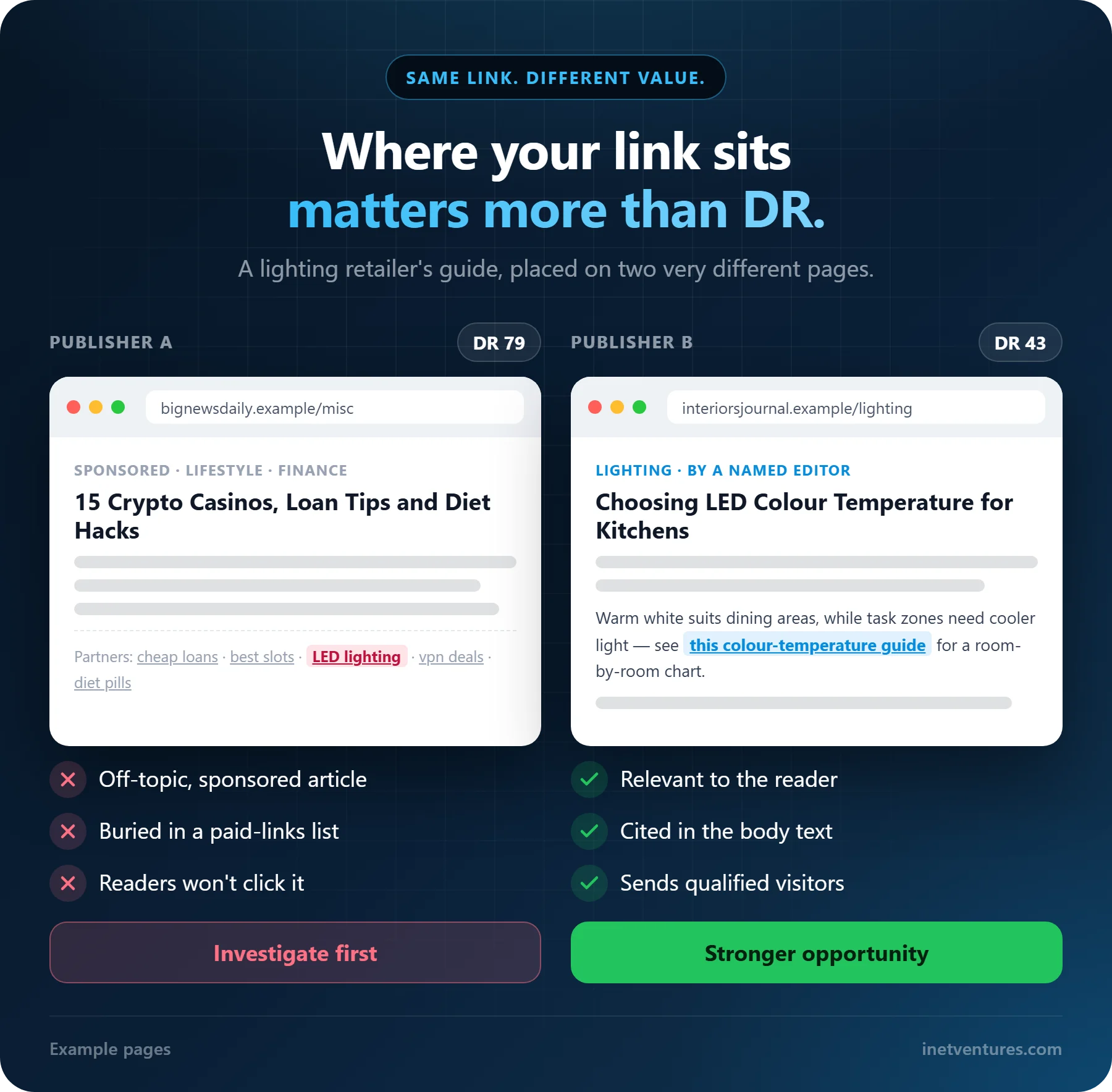
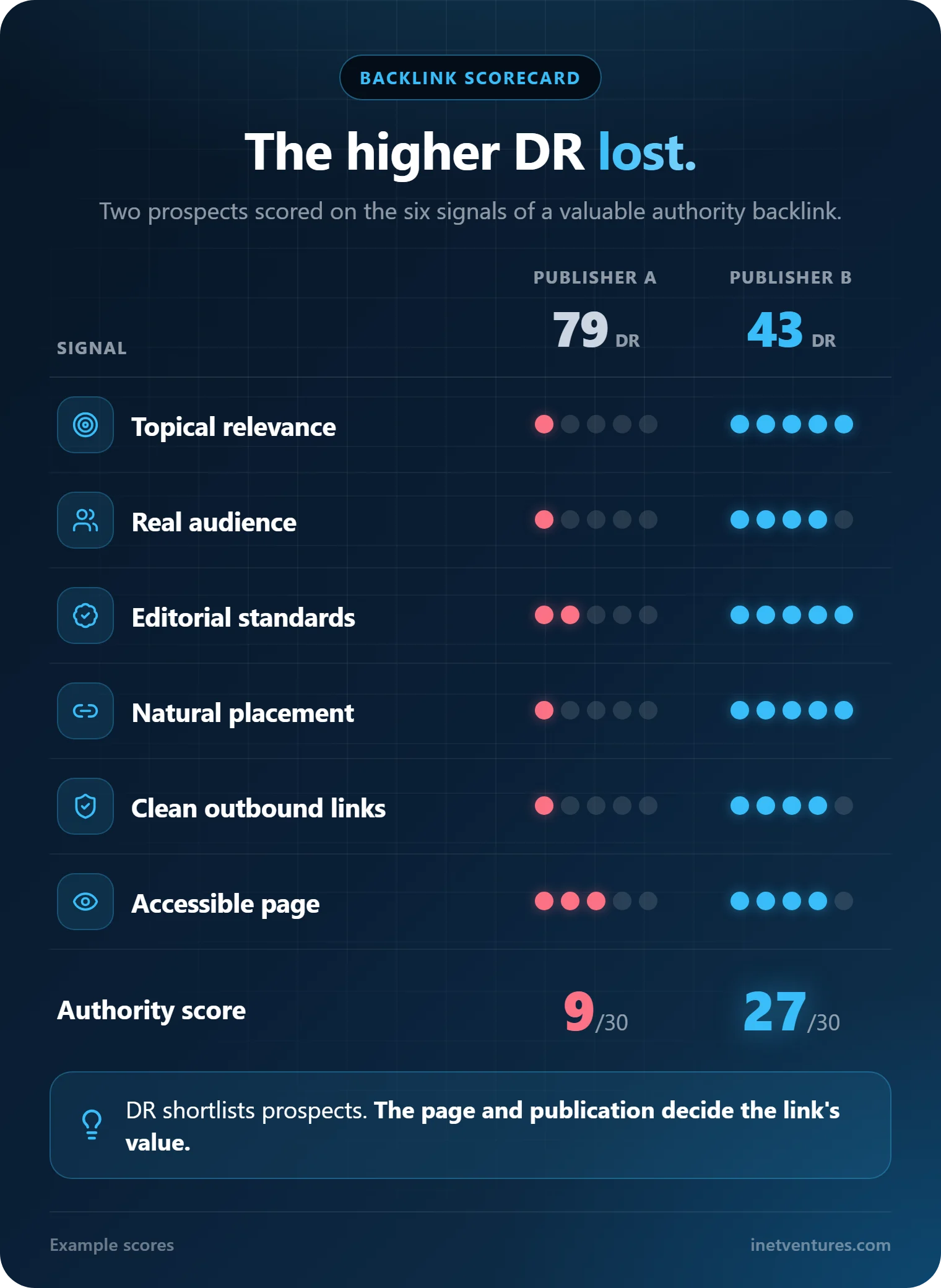
Consider two illustrative outreach prospects:
Publisher B may be the better opportunity despite its lower DR. There is no universal DR threshold above which a backlink becomes valuable, and an individual link's impact cannot be calculated from a domain score alone. Look at the actual page and publication, not only a dashboard number.
Get detailed insights into your backlink quality with Moz, Ahrefs & Majestic data combined.
Authority backlinks can contribute to several objectives, even though no individual link guarantees a ranking increase.
Discovery and context. Links help people and search engines find relevant pages. Clear surrounding text can explain why a resource matters and what topic it covers.
Qualified referral traffic. A citation in a publication read by prospective customers may bring visitors who are more likely to engage, enquire or buy than visitors from an unrelated website.
Reputation and visibility. Being referenced by trade journals, journalists and industry organisations can introduce your business to new audiences and reinforce credibility with people who encounter the coverage.
A stronger ecosystem of references. Multiple independent, relevant sources make it easier for audiences to discover and verify a useful piece of work. This is a better goal than trying to manufacture a particular score.
AI-driven search adds another reason to publish information that is worth citing, but it does not create a proven formula in which a high-DR backlink guarantees an AI citation. Google says the existing SEO fundamentals also apply to its AI search features and that there are no special additional optimisation requirements for inclusion. See Google's AI features guidance.
For 2027, treat traditional search visibility, human readership, earned media and AI referrals as related—but distinct—outcomes. Measure them separately where your analytics tools allow.
Before contacting an editor, use the same checks you would use if you were personally recommending a publication to a client.
A relevant citation from an industry website can be more useful than an off-topic mention from a much larger domain. Check the publication's usual subjects, the article's focus and whether your target page genuinely expands on the reader's question.
Examine estimated search traffic alongside branded searches, recent posts, reader engagement and visible signs that the publication serves an audience. Third-party traffic estimates are imperfect; use them to spot patterns rather than as absolute truth.
Look for named contributors, an identifiable organisation, a sensible editorial policy and articles with original reporting or informed commentary. Be wary of publishers accepting any topic, any anchor text and any destination without reviewing quality.
The strongest context is a sentence where the editor is citing your research, methodology, guide or tool. A forced, keyword-stuffed link is weaker for users even if the host domain has impressive metrics.
Read several recent posts. Is the site linking to relevant sources, or is every article peppered with unrelated commercial links? Also check whether the domain's topic and ownership history make sense. A large DR combined with irrelevant outbound links and collapsing readership is a warning, not a bargain.
Inspect the individual article. Is it live, accessible to readers, linked from elsewhere on the publication and capable of being discovered by search engines? A credible site cannot compensate for an abandoned or inaccessible page.
For a deeper review process, use our website-vetting checklist for guest posts and backlinks.
The best programmes combine assets people actively want to cite with targeted, respectful outreach. Here are eight routes worth testing.
Original research is one of the clearest reasons for another publication to link to you. You do not need a national survey: a carefully documented analysis of your own anonymised business data, a transparent pricing comparison or a reproducible industry dataset can be useful.
Example: A logistics software company publishes an annual analysis of delivery-delay patterns, explains the sample size and methodology, and breaks the results down by region. Relevant trade publications can reference a specific finding and link to the research.
Make the source page easy to cite. Include a clear headline, publication date, methodology, limitations, charts and a contact for questions. Never invent sample sizes or statistics to make a story seem newsworthy.
Monthly retainer combining Blogger Outreach, Link Insert and Digital PR placements. Track everything via your live dashboard.
Editors need reliable sources, timely commentary and useful figures. A subject-matter expert who can explain a new regulation, interpret a market development or correct a common misconception gives journalists a reason to feature the business.
Build a short list of writers covering your actual area, read their recent work and pitch one relevant insight. You can support it with a quote, data or a visual. Understand that a journalist may mention your brand without adding a link; earned editorial decisions belong to the publication.
Read our digital PR guide for campaign formats, or explore iNet Ventures' Digital PR service.
Guest contributions work best when the publisher's readers would benefit from a perspective that is missing from its existing coverage. Offer a specific angle, not a generic promise of “a 1,000-word SEO article”.
For a cybersecurity business, that might be a detailed lesson from conducting security reviews for small firms. For an accounting practice, it might be a practical checklist for a documented rule change. Include a relevant reference to your own resource only where it genuinely supports the article.
Our blogger outreach step-by-step guide covers finding publishers, building relationships and pitching relevant content.
Checklists, templates, calculators, searchable databases and original diagrams often earn links because they help other writers answer a question efficiently.
A property publication might reference a stamp-duty explainer. A technical blog might cite a compatibility tool. A travel writer might link to an updated accessibility map. The asset should be genuinely functional, current and more useful than a thin page created only to attract links.
Aim the outreach at pages already compiling useful resources. Explain what the tool does and why it adds value to that page. Avoid indiscriminate directory submissions.
Broken-link building is simple in principle: find a relevant article pointing to a dead source, identify what the original source covered and offer an accurate replacement.
For example, if an industry association's resource page links to an obsolete guide, you might already have a current version covering the same question. Contact the editor with the broken URL and an optional replacement; do not pressure them to change the link.
Our broken-link building guide explains prospecting, content matching and verification in detail.
Sometimes a publication names your company, quotes your research or describes your product without providing a clickable source. Search for recent brand mentions and check whether a link would help readers verify the claim or access the underlying data.
Keep requests polite: “Thanks for covering the report. If useful for readers who want the methodology, here is the original research page.” Some editors will prefer the existing mention. Coverage can still have reputational value without a backlink.
For more context, see our guide to brand mentions.
A relevant older article may be missing an important development, a working reference or a better explanation. Propose a concise update supported by a resource on your site. This resembles a link insert or niche edit when an editor adds a citation to an existing article.
The crucial distinction is editorial purpose. The addition should improve the page for the reader, not simply squeeze in another keyword anchor. Learn how the process works in our link inserts guide.
Analyse pages in your market that receive links from trade journals, professional bodies or useful resource lists. Ask what those sites are citing: original figures, expert definitions, product comparisons, free tools or definitive guides?
Then create something independently useful that fills a genuine gap. A competitor's link list is a source of prospect ideas, not permission to copy content or send the same generic request to everyone linking to them.
Subject: Source for your article on [specific topic]
Hi [Name],
I enjoyed your [article title], particularly the section on [specific point].
We've recently published [resource title], which includes [one original finding, tool or explanation]. It may be useful as an additional source for readers interested in [specific question].
Here is the resource: [URL]
No problem if it isn't a fit. Thanks for taking a look.
[Your name]
Keep your pitch short. Reference the actual page, explain the benefit to its readers and avoid asking for an exact-match anchor. A well-targeted follow-up is reasonable; a relentless automated sequence is not.
Expert quotes via Digital PR — your spokesperson quoted in DR 50+ publications.
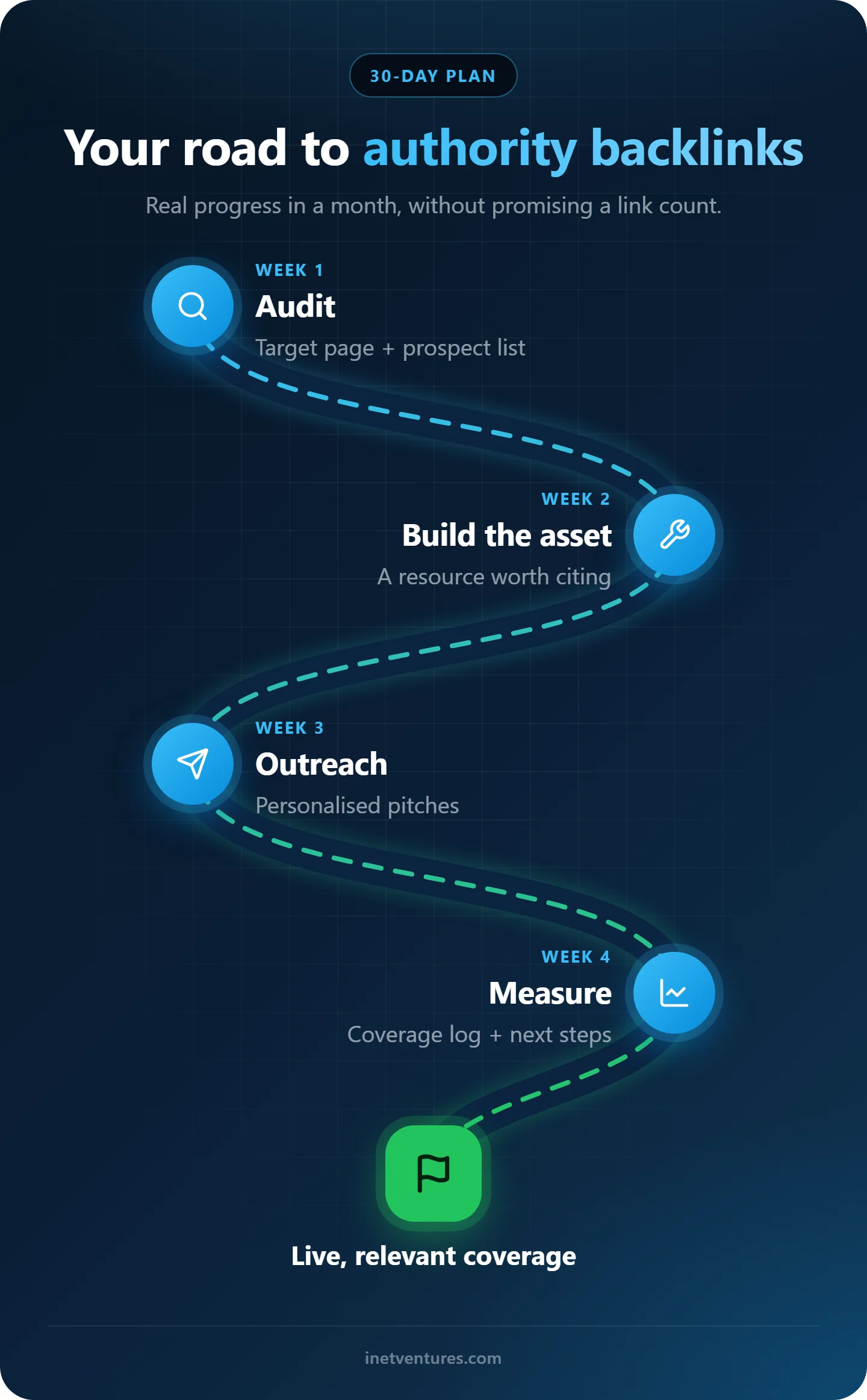
You can make real progress in a month without promising a fixed number of links.
| Period | Priority | Deliverable |
|---|---|---|
| Week 1 | Audit your strongest pages, existing backlinks and competitors' cited resources | One link-worthy target page and a qualified prospect list |
| Week 2 | Improve or create the asset; check sources, visuals, evidence and mobile usability | A publishable resource worth recommending |
| Week 3 | Personalise relevant journalist, resource-page and specialist-publisher outreach | A documented outreach campaign with clear reasons for each pitch |
| Week 4 | Follow up selectively, verify coverage and review performance | Live-coverage log, lessons learned and the next month's improvements |
Before launching outreach, ensure the target page itself is worth visiting. An excellent publication cannot fix an unhelpful destination.
There is a vital distinction between paying for content production or outreach services and buying links intended to pass ranking credit. Google's link spam policies list paid links for ranking purposes, excessive exchanges, automated link creation and certain manipulative guest-post practices as spam.
If a publisher has been compensated for a link or article, Google recommends qualifying the link with rel="sponsored" (with nofollow also acceptable). See Google's outbound-link qualification guidance. A promise of an unqualified “dofollow” link in exchange for payment is not proof of compliance.
Avoid private blog networks, sites built mostly to sell outgoing links, bulk exact-match anchors and irrelevant articles written only to host a destination URL. If the opportunity is difficult to justify to a real reader, it is unlikely to be the foundation of a resilient strategy.
Treat link acquisition as the start of measurement, not the finish line. Track:
Rankings can move for many reasons, including content changes, competition and algorithm updates. Do not automatically attribute every improvement or decline to one backlink. Judge the programme over a meaningful period and keep improving the pages that earn attention.
A high-DR backlink is simply one from a domain with a high score in Ahrefs. An authority backlink is an editorially credible, relevant citation that makes sense for readers. The two may overlap, but neither DR nor DA alone proves link quality.
There is no universal cut-off. A relevant DR 35 trade publication can be a stronger prospect than an unrelated DR 75 website. Use DR to shortlist opportunities, then review the actual site, article, audience and outbound links.
There is no reliable fixed number. Search competition, content quality, search intent, existing reputation and the types of pages linking to you all matter. Benchmark comparable competitors' relevant referring domains rather than copying a raw link count.
No. Government and educational domains can host valuable authoritative resources, but a domain ending alone does not confer special guaranteed ranking value. Relevance, editorial context and the real page still matter.
They can. A nofollow link may still bring qualified traffic, publicity and discovery by people. However, it should not be sold as a guaranteed way to pass ranking credit. Google treats link attributes as signals rather than simplistic guarantees.
You can pay an agency for research, content, creative work and outreach, and you can buy properly disclosed advertising or sponsored coverage. But buying links to manipulate search rankings—particularly unqualified followed links—conflicts with Google's published spam policies. Disclose compensated publisher placements appropriately.
There is no reliable timetable. A new citation may be discovered quickly, while any measurable change to organic visibility may take longer—or may not be detectable at all. Monitor the linked page's search performance, referral traffic and conversions rather than expecting a guaranteed lift after a set number of days.
They can support wider discoverability and credibility, but there is no published rule saying a backlink of a particular DR will cause an AI Overview citation. Google's advice is to follow existing search best practices and make helpful, indexable content.
The most durable authority backlink strategy for 2027 is straightforward: publish something worth citing, identify the people who genuinely need it and earn editorial references in places your audience trusts.
That requires more judgement than chasing a headline DR figure. But it also produces the kind of links that make sense beyond SEO reports: links that bring relevant readers, support a claim and help a business become better known within its field.
If you need help researching suitable publishers, creating relevant articles or pitching newsworthy stories, explore iNet Ventures' Blogger Outreach service, Digital PR services and our wider link-building services.
James is the founder and CEO of iNet Ventures, bringing over two decades of experience in SEO, link building, and online growth. He has helped online agencies scale through white-label solutions and has overseen the delivery of 25,000+ links, combining proven strategies with AI-driven workflows to drive efficient, long-term results.
Explore services, view pricing and manage campaigns in one place.
No subscription required • 100% white-label
Related Articles
Continue exploring our latest insights and strategies for digital marketing success.



