Your hosting provider can quietly sabotage your search rankings. Learn how server speed, uptime, TTFB, and shared IP reputation affect SEO performance — and what to look for (and avoid) when choosing a host.
Website hosting is often treated as a background decision, especially in the early stages of a project. Many businesses prioritise design, content, and marketing while assuming that hosting simply “works.” In reality, hosting quality plays a direct role in search engine optimisation (SEO), influencing how websites are crawled, indexed, and ranked.
Choosing the wrong hosting environment can quietly undermine even the best SEO strategies. From slow page speeds to downtime and scalability issues, poor hosting introduces friction that affects both users and search engines.
Page speed is one of the most well-established ranking factors in Google’s algorithm. With the introduction of Core Web Vitals, performance metrics such as Largest Contentful Paint (LCP), First Input Delay (FID), and Cumulative Layout Shift (CLS) have become even more critical.
Hosting directly affects these metrics. Low-quality shared hosting environments often result in slower server response times, which increases load times across all pages. Even well-optimised websites can struggle to perform if the underlying infrastructure is weak.
A slow website leads to:
All of these factors contribute to weaker rankings over time.
Search engines rely on consistent access to websites in order to crawl and index content. If a site experiences frequent downtime, search engine bots may encounter errors when attempting to access pages.
Repeated downtime can result in:
Even short outages can have an impact if they occur during peak crawl times. For websites investing in SEO or digital PR, downtime can mean that newly acquired backlinks are not properly recognised or indexed.
The relationship between hosting quality and SEO can be summarised across several key factors:
| Factor | Description | SEO Impact Level | Direct/Indirect Impact |
|---|---|---|---|
| Server Response Time (TTFB) | The time it takes for a server to respond to a browser request. | Critical | Direct: Google uses TTFB as a core speed metric. |
| Uptime/Reliability | The percentage of time your site is accessible (99.9% standard). | Critical | Direct: Prevents crawlers from indexing; avoids de-indexing risks. |
| Server Location | The physical distance between the data center and the audience. | High | Indirect: Increases latency, hurting Core Web Vitals. |
| SSL/HTTPS | Security encryption provided by the host. | High | Direct: Confirmed ranking signal and user trust factor. |
| Scalability | Ability to handle traffic spikes without crashing. | Moderate | Indirect: Performance drops during surges hurt UX signals. |
| Core Web Vitals Support | Optimization for LCP and CLS metrics. | High | Direct: Specific user-centric ranking factors in the algorithm. |
Digital PR campaigns and link-building efforts are designed to drive traffic and improve authority. However, these campaigns can backfire if hosting cannot handle increased demand.
When a website experiences a surge in traffic:
This results in lost engagement and wasted link equity. Backlinks from high-authority publications are most valuable when they lead to a stable, fast-loading destination. Poor hosting can dilute the benefits of these links.
Low-cost hosting options can be appealing, particularly for startups or small businesses. Introductory offers and discounts provide an accessible entry point, but they often come with trade-offs.
For example, options like an IONOS web hosting discount may reduce upfront costs, but it is important to evaluate what happens after the promotional period. Pricing increases, performance limitations, and restricted scalability can all affect long-term SEO outcomes.
Common issues with cheaper hosting plans include:
While cost efficiency is important, prioritising price over performance can lead to higher expenses in the long run through lost traffic and reduced rankings.
Server location can influence load times, particularly for geographically targeted audiences. If a website’s server is located far from its primary users, latency increases, resulting in slower page loads.
For businesses targeting specific regions:
Although server location is not a primary ranking factor, its impact on performance makes it relevant to SEO.
Security is another important aspect of hosting that affects SEO. Google has confirmed that HTTPS is a ranking signal, and secure hosting environments are essential for maintaining user trust.
Poor hosting can expose websites to:
These issues can lead to warnings in browsers, reduced user confidence, and potential ranking drops. A reliable hosting provider should include robust security measures, including SSL certificates, firewalls, and regular updates.
As websites grow, their hosting requirements change. Increased traffic, larger databases, and more complex functionality require scalable infrastructure.
A hosting provider should allow for:
Without scalability, businesses may face performance bottlenecks that limit growth. Migrating to a new hosting provider can also introduce SEO risks if not managed carefully, including temporary downtime and changes to site structure.
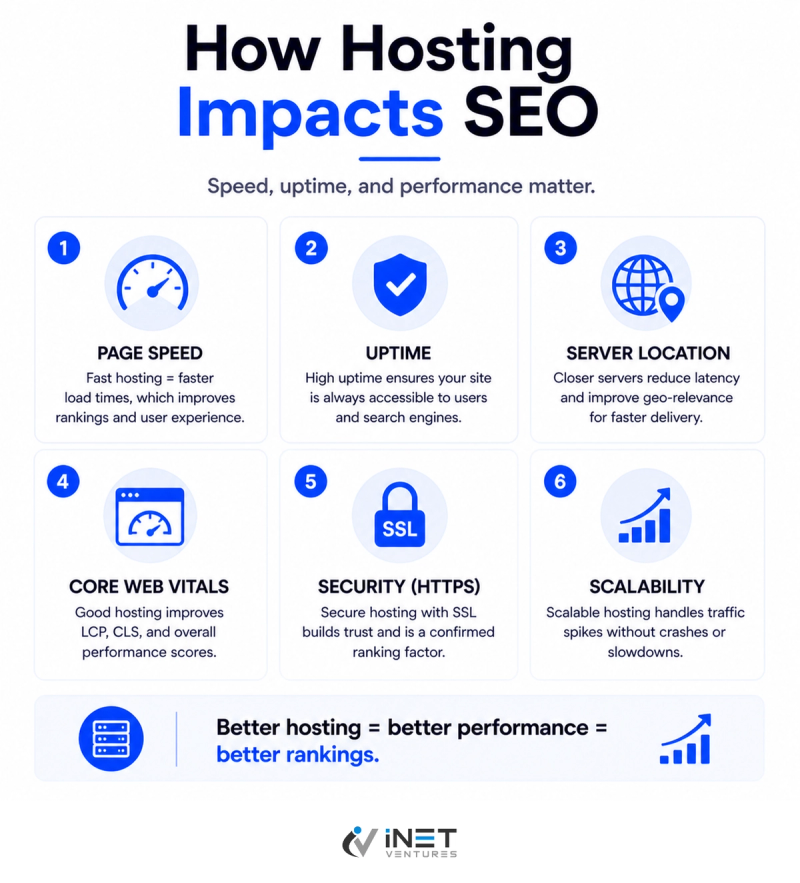
Hosting is not just a technical necessity; it is a critical component of SEO performance. Factors such as page speed, uptime, security, and scalability all influence how search engines evaluate and rank a website.
While cost-saving options and discounts can be useful in the early stages, long-term performance should remain the priority. A reliable hosting environment supports consistent growth, protects SEO investments, and ensures that marketing efforts deliver their full value.
Businesses that treat hosting as a strategic decision rather than a basic requirement are better positioned to build sustainable search visibility and maintain strong online performance over time.
Explore services, view pricing and manage campaigns in one place.
No subscription required • 100% white-label
Related Articles
Continue exploring our latest insights and strategies for digital marketing success.



![Insider Instagram Tips [2026 Guide]](/_next/image?url=https%3A%2F%2Fcdn.sanity.io%2Fimages%2F90630dz3%2Fproduction%2Fe1d9c1ac1321fbf3cfd8d993a935a7b5873d68e4-1600x2000.jpg%3Fw%3D1200&w=3840&q=75)
![How to Increase X Followers - 30 Tips and Tricks [2026]](/_next/image?url=https%3A%2F%2Fcdn.sanity.io%2Fimages%2F90630dz3%2Fproduction%2Fdd58619f91e7cf66ffddbc41dea4435f6458221f-1672x941.png%3Fw%3D1200&w=3840&q=75)