Qwant is the French privacy-first search engine building an independent European index with Ecosia. What it is, how it works, who owns it, and whether it matters in 2026.
Qwant is a French privacy-first search engine that doesn't track you. No search history, no user profiling, no personalised ads — results are ad-supported but ads follow your query, not your identity. Founded in 2013 and majority-owned by cloud provider OVH, it's also the default search engine for the French state administration — and since 2025 it's been co-building an independent European search index with Ecosia.
Most "Google alternatives" aren't really alternatives underneath: they rent Google or Bing's index and reskin it. Qwant is interesting precisely because it's become less true of it. Here's what it is, how it works, and why the 2026 version is genuinely different from the one older reviews describe.
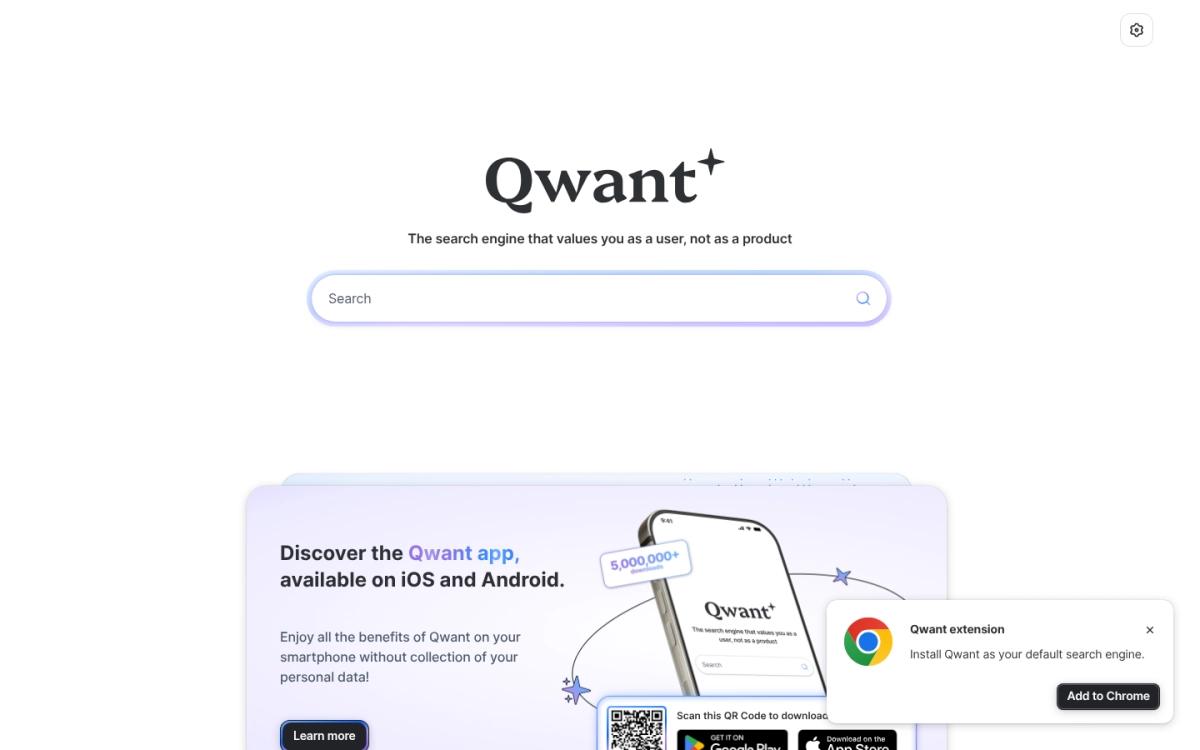
Qwant is a search engine launched in 2013, headquartered in Paris and majority-owned by European cloud company OVH. Its pitch is simple: a full web search engine that complies with GDPR by design rather than by policy. It doesn't store your search history, doesn't build an advertising profile on you, and doesn't sell or share personal data — its servers and operations sit in Europe.
The product family is broader than the homepage suggests:
Contextual advertising. Qwant shows sponsored results based on the keywords you just typed — the same way Google worked before behavioural targeting — via an advertising partnership with Microsoft. A search for "running shoes" might show shoe ads; it won't follow you around the web afterwards because there's no "you" to follow.
That model is weaker than Google's personalised engine financially, which is part of why Qwant has stayed small: a fraction of a percent of global search volume, with its real strength in France and Germany. It's also the default engine across the French state administration, which gives it a legitimacy most privacy engines lack.
Until recently, Qwant — like DuckDuckGo, Startpage and most alternatives — leaned heavily on Microsoft's Bing API for its results. That changed materially in 2024–2026:
In plain terms: Qwant is transitioning from "privacy front-end on Bing" to "search engine with its own European index". That makes it the most technically meaningful Google alternative in Europe — even if its share remains small.
Country and language targeting for Blogger Outreach & Link Inserts across 30+ markets (.de, .fr, .es, .au…).
Lightly, for now — but less dismissibly than a year ago:
Set qwant.com as your default search engine in Chrome, Firefox, Edge or Safari (most browsers support it natively in settings), install the extension or app, and live with it for a week. The honest test isn't whether it beats Google — it's whether you notice.
Yes — it's funded by contextual ads matched to your current query rather than your personal data, so there's no subscription and no tracking.
Qwant is majority-owned by OVH, a European cloud provider. It was founded in Paris in 2013 and remains headquartered there under European jurisdiction.
Partly. Since 2025, Qwant has served results from the independent European Search Perspective index it co-owns with Ecosia — live for French and German content — while supplementing coverage elsewhere with partner results.
For privacy, yes — categorically. For index depth and long-tail coverage, no — Google's index is still far larger and more current, particularly outside France and Germany.
No — Qwantbot crawls the open web and respects robots.txt. If your site is accessible to search engines, it can be indexed without registration.
Last reviewed: November 2026.

James is the founder and CEO of iNet Ventures, bringing over two decades of experience in SEO, link building, and online growth. He has helped online agencies scale through white-label solutions and has overseen the delivery of 25,000+ links, combining proven strategies with AI-driven workflows to drive efficient, long-term results.
Explore services, view pricing and manage campaigns in one place.
No subscription required • 100% white-label
Related Articles
Continue exploring our latest insights and strategies for digital marketing success.


