How to find unlinked brand mentions with Google, Ahrefs and Semrush, verify they are genuinely unlinked, prioritise the ones worth pursuing and turn them into editorial backlinks — with three outreach templates.
Your brand might already be appearing on relevant websites without receiving a backlink.
Perhaps a journalist has quoted your founder, an industry publication has recommended your product, or a blogger has included your company in a comparison. The mention creates exposure, but readers have no direct link to follow.
These are known as unlinked brand mentions, and they can be useful opportunities for earning editorial backlinks.
Unlike traditional cold link-building outreach, you are approaching someone who has already chosen to reference your business. The task is to identify worthwhile mentions, establish whether a link would genuinely help readers, and make a polite request to the publisher.
This guide explains how to find unlinked brand mentions using free and paid tools, assess their value, contact editors, and measure the results.
An unlinked brand mention occurs when another website references a business, product, person or resource without including a clickable link to the relevant website.
Consider a hypothetical article discussing SEO providers:
“Several companies, including iNet Ventures, provide white-label link-building services for agencies.”
If the publisher writes "iNet Ventures" as ordinary text, that is an unlinked brand mention. If the publisher makes the company name clickable and directs readers to the official website, it becomes a linked mention.
The difference may appear small to a reader, but it matters when analysing a website's backlink profile. A link can help visitors discover the original source and can provide search engines with additional information about the relationship between pages.
Google's official link best practices explain that links are used to discover pages and as a signal when determining relevance.
Unlinked mentions are not restricted to company names. They can involve several forms of brand recognition.
| Mention type | Example | Potential opportunity |
|---|---|---|
| Company name | A business named in an industry article | Link to the company website |
| Product or service | A software product listed in a comparison | Link to the official product page |
| Founder or expert | An executive quoted in a news article | Link to a relevant biography or company page |
| Original research | Statistics attributed to a company's report | Link to the original research |
| Images or infographics | Original visuals reproduced with attribution | Link to the original resource |
| Case studies | Results or examples discussed by another publication | Link to the original case study |
| Brand-name variations | A shortened name or common misspelling | Link to the correct source where helpful |
One of the more overlooked opportunities is original research attribution. If another publication uses figures from your company's report, linking to the research can help readers verify the methodology and explore the findings.
That is a stronger editorial reason to request a link than simply asking for one because your company was mentioned.
The answer depends on what you mean by SEO value.
An unlinked mention can provide brand exposure, help prospective customers discover a company, and introduce its name to relevant audiences.
However, an unlinked mention is not a backlink.
Google has explained that an ordinary text reference does not pass the same link signal as a hyperlink. The distinction is important because marketers sometimes assume that every brand mention provides the same search benefit as an editorial link.
Links have established roles in Google's crawling and ranking systems. The independent ranking effect of unlinked mentions is less clearly established.
There is also a growing distinction between traditional SEO and AI-search visibility. A company can appear in online discussions, articles and reviews that AI systems may retrieve or reference. Yet the presence of a brand mention does not guarantee that ChatGPT, Google AI features or another system will recommend that company.
For a balanced approach, measure three outcomes separately:
This separates measurable outcomes from assumptions about search algorithms.
Get detailed insights into your backlink quality with Moz, Ahrefs & Majestic data combined.
There is no single database containing every mention of every brand. Different platforms maintain different indexes, and some mentions are difficult to discover.
For most businesses, combining Google Search, monitoring tools and manual checks creates a practical starting point.
Google Search provides a free way to identify websites referencing your brand.
Start by searching for your company name in quotation marks:
"iNet Ventures"
Quotation marks help focus the results on that phrase. Next, exclude your own website:
"iNet Ventures" -site:inetventures.com
This searches for references outside the company's domain. You can expand the search to account for name variations:
"iNet Ventures" OR "iNetVentures" -site:inetventures.com
If your company name is also a common word or phrase, add industry-related terms to reduce irrelevant results. For example, a software company might combine its brand name with "software", "platform" or a distinctive product name.
Important: These searches identify potential mentions, not confirmed unlinked mentions. Some results may already link to your website, while others may refer to an unrelated business. Open each promising result and inspect the actual article.
Another useful technique is to search for exact sentences from your own research, presentations or case studies. This can reveal publications referencing your information without attributing the original source.
Searching manually is useful for an initial audit. Monitoring helps identify future mentions without repeatedly running the same searches.
Google Alerts can email you when Google discovers new results matching your chosen terms. To get started:
Google's official instructions explain how to configure and manage alerts.
For an established business, useful alerts might include the company name, distinctive product names, senior spokespeople and original research titles. A company with a relatively common name should be more selective to avoid excessive irrelevant notifications.
Google Alerts is not a complete brand-monitoring database. It may miss mentions, and it does not automatically establish whether a result contains a backlink. Treat alerts as a discovery mechanism rather than a definitive backlink report.
Ahrefs is useful for businesses that want to investigate larger numbers of mentions and assess the websites publishing them. Its Content Explorer searches a large database of published web pages.
A practical workflow is:
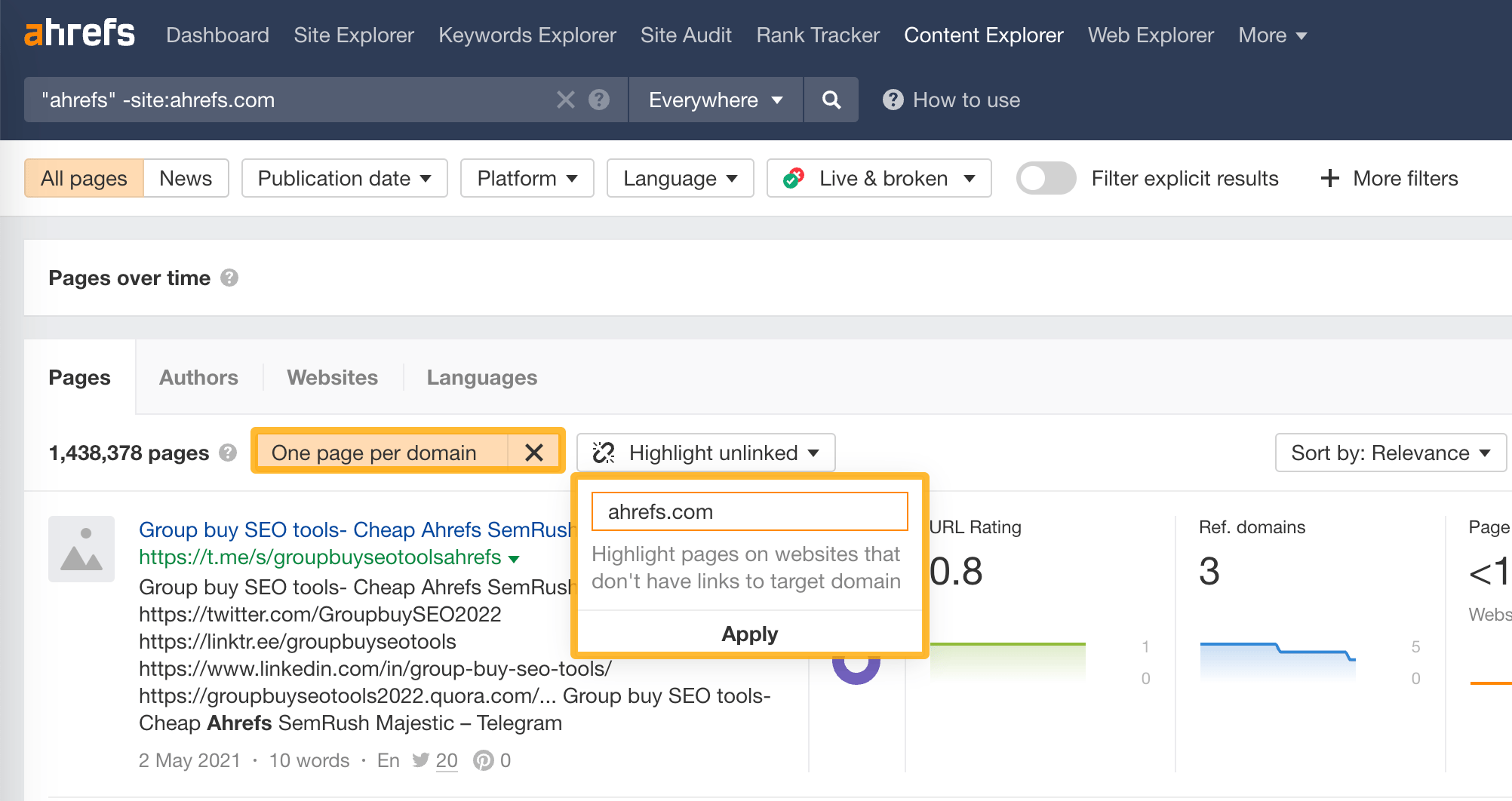
Ahrefs documents this method in its Content Explorer link-building training.
There is an important distinction here: highlighting domains without known backlinks is not the same as confirming that a particular article has no link. A website could already link to your homepage from one article while referencing your company without a link in another. For that reason, check promising pages individually.
Ahrefs also distinguishes between All pages and News searches. All pages provides broader content discovery, while News focuses on coverage from a selected set of news publications. The company's September 2026 guidance explains this difference.
Semrush offers another approach for identifying and organising brand mentions. Its Brand Monitoring tools can track references across different sources and help distinguish linked and unlinked coverage.
The process involves creating a brand-monitoring query, entering the company name and website, choosing relevant sources, and reviewing the resulting mentions. Where available, a backlink filter helps narrow the results to references without links to your site.
Semrush's guide to finding unlinked mentions demonstrates the process, including prospect evaluation and outreach.
As with Ahrefs, automated classifications should be manually checked before contacting a publisher.
Monthly retainer combining Blogger Outreach, Link Insert and Digital PR placements. Track everything via your live dashboard.
| Method | Best suited to | Main advantage | Limitation |
|---|---|---|---|
| Google Search | Small businesses and initial audits | Free, straightforward discovery | Manual checking required |
| Google Alerts | Ongoing monitoring | Notifications of new results | Incomplete coverage |
| Ahrefs Content Explorer | SEO teams and agencies | Broad discovery and prospect metrics | Paid access and manual validation |
| Semrush Brand Monitoring | Brand and PR teams | Monitoring and filtering workflows | Access and features depend on subscription |
| Google Search Console | Existing backlink verification | First-party link reporting | Does not find unlinked mentions directly |
For an agency managing multiple clients, a sensible setup is a discovery tool, a shared prospect list and a consistent verification process. There is little value in collecting hundreds of results if nobody checks whether the sites are relevant or whether the mentions are actually unlinked.
Before requesting anything from a publisher, verify what appears on the live page.
For existing backlinks, the Google Search Console Links report can provide useful supporting information. However, Google explicitly describes this report as a sample rather than a complete record of every backlink. You should therefore avoid interpreting an absent Search Console record as definitive proof that a website does not link to you.
Finding opportunities is only half the process. A mention on a relevant, trusted industry publication may be more worthwhile than several references on websites with little editorial oversight.
Before making contact, assess each opportunity against the following factors.
| Evaluation factor | High-priority signal | Warning sign |
|---|---|---|
| Topical relevance | Publication covers your industry | Unrelated or generic content |
| Editorial quality | Original reporting, credible authors | Scraped or mass-produced content |
| Mention context | Brand or research is discussed meaningfully | Passing reference with little relevance |
| Reader usefulness | A source link would help visitors | No clear reason for a link |
| Publication activity | Article is recent or maintained | Abandoned or inaccessible page |
| Audience | Readers overlap with potential customers | Little connection to your target market |
| Existing links | A relevant link is genuinely absent | The source is already linked appropriately |
For teams handling large prospect lists, we recommend a practical five-factor scoring system. Award 0, 1 or 2 points for each of these:
The maximum score is 10. An 8–10 result might deserve prompt outreach. A 5–7 result warrants further review. Lower-scoring opportunities can usually wait.
This is a suggested editorial prioritisation framework, not a Google ranking metric or a scientifically validated predictor of outreach success. Domain Rating, Domain Authority and estimated traffic can support the assessment, but should not replace it.
If you need to inspect a potential publisher's metrics, the iNet Ventures Backlink Analyzer provides a starting point for examining backlink-related indicators.
Once you have identified a genuine opportunity, contact the person responsible for the article. This might be the writer, editor, publication manager or website owner.
The best requests are short, specific and helpful. Avoid sending a generic message stating that your website needs more backlinks. The publisher has no obligation to support your SEO campaign. Instead, explain how the link could improve the article for its readers.
Hi [Name],
I enjoyed reading your article on [topic], particularly your point about [specific detail]. Thanks for mentioning [Brand] in the piece.
I noticed the company name isn't linked. If you think it would be useful for readers, our official page is here: [URL]. It provides some additional information about the service you've mentioned.
Thanks again for including us.
Best,
[Your Name]
Hi [Name],
I noticed you referenced our research on [topic] in your recent article. Thanks for including the findings.
If it's helpful, the original study is available here: [URL]. It includes the methodology and supporting information, which your readers may find useful.
Would you consider adding the source link alongside the reference?
Best,
[Your Name]
Hi [Name],
Thanks for featuring [Expert Name] in your article about [topic].
I wanted to share their official biography and background information in case it's useful as a reference: [URL]
If appropriate, feel free to link to it from the mention so readers can learn more about their experience.
Thanks for the coverage.
Best,
[Your Name]
Get featured on real, high-authority blogs in your niche with our white-label blogger outreach service.
The messages are deliberately concise. They identify the existing article, acknowledge the publisher's work, provide a relevant destination and leave the editorial decision with the recipient.
A small amount of personalisation is preferable to sending identical messages to hundreds of publishers.
If a publisher declines, respect the decision. One reasonable follow-up may be appropriate, but repeated demands can damage a relationship that was previously positive.
A common mistake is asking every publisher to link to the homepage. The most appropriate destination depends on what the article discusses.
Keep the suggested anchor text natural. The existing company name, report title or source reference will often make more sense than an exact-match commercial keyword. Google's guidance on descriptive link text supports using wording that helps readers understand the destination.
The purpose is to make the citation useful, not to force a particular keyword into the article.
Tracking becomes increasingly important when you manage multiple brands or SEO clients. A spreadsheet or outreach management system should record the entire process, not just successful links.
Useful fields include:
| Field | What to record |
|---|---|
| Brand or client | Business being monitored |
| Mention URL | Exact page containing the reference |
| Publisher | Website or publication name |
| Date discovered | When the opportunity was identified |
| Mention context | How the brand is referenced |
| Target URL | Most appropriate source page |
| Editorial assessment | Relevance and quality score |
| Contact | Writer or responsible editor |
| Outreach status | Not contacted, sent, follow-up, accepted or declined |
| Live link | Verified final link and destination |
| Link attributes | Whether the link uses nofollow, sponsored or other attributes |
| Outcome | Referral traffic, enquiries or other measurable results |
Consider a hypothetical campaign:
That would represent a 30% conversion rate from contacted publishers. These figures are illustrative, not actual iNet Ventures results or an industry benchmark.
Reporting should clearly distinguish discovered mentions, qualified opportunities, outreach activity and successfully published links. For agency clients, that distinction provides a much more useful picture than reporting a single number labelled "links built".
These two terms are closely related, but they are not identical.
Unlinked mention outreach starts with an existing text reference that does not contain a link.
Lost-link reclamation generally involves recovering a hyperlink that previously existed but has since disappeared, stopped working or begun pointing somewhere unsuitable. For example, a publication may have linked to an old product URL that now returns a 404 error. The appropriate action could be to restore the old page, redirect it to a relevant replacement, or ask the publisher to update the destination. Another example is an article that previously linked to your website but was revised, removing the reference. Our guide to why links break covers the common causes.
Both activities belong within a broader backlink maintenance strategy. They also differ from link insertion services, which involve obtaining a contextual placement within existing published content rather than reclaiming an already-earned brand citation.
Keeping these methods separate helps agencies set accurate client expectations.
Not every brand reference needs a hyperlink. A passing mention in a news report or a brief entry in a long list may be entirely appropriate without one. Prioritise cases where the link provides useful additional context.
Third-party authority scores are screening metrics, not Google ranking scores. A specialist publication with a relevant audience may offer more practical value than a larger website covering unrelated subjects.
Generic messages often fail to explain why a publisher should revisit an existing article. Reference the actual content and identify a helpful destination.
An editor voluntarily adding a relevant source link is different from purchasing an advertising placement. Google's link spam policies identify buying or selling links for ranking purposes as a violation. Paid or sponsored links should use appropriate attributes such as rel="sponsored" or rel="nofollow". Manual outreach alone does not make a paid link compliant.
Online brand coverage can contribute to discoverability and reputation, but it cannot guarantee recommendations or citations from AI search tools. Measure actual visibility and referral outcomes rather than presenting speculative ranking benefits as confirmed results.
Link reclamation works best when a brand already attracts attention. An established company may receive regular references from journalists, bloggers, customers and industry publications. A newer business may have very few mentions to recover.
In that situation, the challenge is not simply finding unlinked references. It is creating something worth referencing. That could include original industry data, expert commentary, a helpful free tool, a useful case study or a distinctive product announcement.
This is where digital PR campaigns can complement ongoing backlink monitoring. Digital PR focuses on developing stories and expertise that relevant publications may choose to cover. Monitoring then helps identify what happened after publication, including whether journalists mentioned the company, linked to a source or discussed the story elsewhere.
iNet Ventures also provides a Brand Mentions service focused on placing brands within relevant editorial content. This is a separate activity from finding and reclaiming existing unlinked mentions, so the objectives, placement arrangements and expected deliverables should be assessed independently.
For agencies, the broader goal is a consistent process for building recognition, earning relevant coverage, and recording the business value of that work.
If you have never audited unlinked brand mentions before, begin with a manageable exercise.
Then create monitoring alerts and maintain the prospect list as new coverage appears.
The first audit may produce several opportunities or none at all. Both outcomes are useful: they establish how visible your brand currently is and whether reclamation deserves an ongoing place in your SEO strategy.
An unlinked brand mention is a reference to a company, product, person or original resource on another website without a clickable hyperlink to the relevant source.
They can contribute to brand awareness and help people discover a business. However, they are not equivalent to backlinks. Google has documented roles for crawlable links, while the independent ranking impact of unlinked mentions is less certain.
Use Google Search with your brand name in quotation marks, exclude your own website using -site:, and manually check the resulting pages. Google Alerts can help monitor newly discovered references.
Yes. Ahrefs Content Explorer supports brand-mention discovery and provides functionality for highlighting domains without known links to your website. Results should still be checked at the individual page level.
A brand mention is a reference to a business or its assets. A backlink is an actual hyperlink from another website to yours. A mention can contain a backlink, but it does not have to.
No. Focus on reputable, relevant content where a link would genuinely help the audience. Publishers retain control over whether to include a hyperlink.
Discovery and qualification can begin immediately, but publisher responses vary. Some editors may update articles quickly, while others may not respond or may choose not to make changes. There is no guaranteed turnaround.
An unlinked mention has no hyperlink to the relevant source. A lost backlink previously existed but has disappeared or stopped functioning as intended. The two situations require different verification and recovery steps.
They can contribute to a brand's wider online presence, but there is no guaranteed direct ranking benefit across AI systems. Different platforms retrieve, interpret and cite information differently. Actual AI visibility should be monitored separately.
It can be more efficient when a credible publication has already referred to your company and adding a source link would help readers. However, a brand with limited existing coverage will also need to create useful content and earn new editorial attention.
Unlinked brand mentions are worth reviewing because they represent recognition your business has already earned.
The most effective approach is not to chase every mention or request a hyperlink from every publisher. It is to identify relevant coverage, verify whether a source link is missing, assess the editorial value, and make a thoughtful request when there is a genuine benefit for readers.
For SEO agencies and established brands, this can become a useful recurring activity alongside backlink monitoring, content development and digital PR. And for businesses that are not yet receiving regular mentions, the priority should be producing expertise, research and resources that others naturally want to reference.
Want to build more relevant coverage for your brand or clients? Explore iNet Ventures' link-building and digital PR services to compare the approaches available for your campaign.
Last reviewed: November 2026.

James is the founder and CEO of iNet Ventures, bringing over two decades of experience in SEO, link building, and online growth. He has helped online agencies scale through white-label solutions and has overseen the delivery of 25,000+ links, combining proven strategies with AI-driven workflows to drive efficient, long-term results.
Explore services, view pricing and manage campaigns in one place.
No subscription required • 100% white-label
Related Articles
Continue exploring our latest insights and strategies for digital marketing success.


